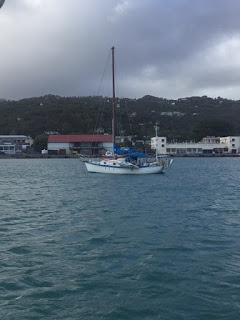
There was only one other yacht in the "turning basin" anchorage when I arrived, a yacht even smaller than Shanti, which always makes me feel better about my diminutive size. "Beguine" is only 27' and is circumnavigating with father and son, Ron and Mark, from Florida.
Fortunately for me, both are engineers with decades of experience of dealing with every conceivable problem that might beset anything. They are the kind of guys who once faced with a problem gnaw away at it until the best solution is found. And so they did for three days after looking up at the rat's nest of my unravelling rigging, each morning presenting me with different options to consider. They were totally respectful and left it to me to accept or reject their ideas.
They came prepared with miles of rope, block and tackle for independent mast climbing.
We decided to hacksaw the T toggles off the upper ends of the stays, re-lay the unravelled wires, wrap something strong around the mast above the spreaders and join them together with D-clamps, or "bulldog" clamps.
The unravelling wires on the lower stays.
A lot of this kind of temporary fix depends on what's available. Luckily there's a Chinese "hole in the wall" store in town, well hidden behind a steel red door, that seems to sell a mixed bag of everything, from eggs to hardware.
A couple of years ago, back in Melbourne, good friend Peter Dransfield was clearing out his garage and gave me some cables suitable for locking up a dinghy. One of these was quite heavy duty, about two metres long with a swaged eye at each end.
We stripped the PVC coasting off the end of the cable to attach the stays to.
Hacksawed in half and threaded through the eye it made a perfect sling for going diagonally above the spreaders. The cut off end of the stays could then be joined to this using the D-clamps.
It looks a bit like part of a shell necklace.
About an hour after finishing the job, the huge Canadian yacht "Dream Catcher" arrived. Norm was glad to find nothing remaining to be done apart from giving it the thumbs up. I was still very appreciative of their support all the way here, knowing they were only a few days behind me and ready to rescue me if needed.
Next morning, the other single handed female sailor, Eve, arrived on her beautiful US ketch "Auntie".
We leave today, me at 0900 for Mauritius, they at midday for La Reunion. Ron and Mark, who have already been here 7 weeks, leave Friday for Durban.
With continuing good luck, I should find a competent rigger in Mauritius with all the necessary parts to replace our jury rig for something more permanent. Should be there by Saturday morning.....
Someone recently said I have had more than my fair share of bad luck and the rest of this trip should be plain sailing. What's that about tempting fate?
Another unplanned detour, though not so far out of the way this time, was again thrust upon me by circumstances beyond my control - aren't they all?. Here, in an unscheduled stop at Port Mathurin, Rodrigues, I'm only about 3 days short of my intended next port of Mauritius, but didn't want to push my luck with faulty rigging and potential dismasting.
What happened?
Here's a suggestion from a friend of daughter, Pandora's, as to the potential inherent weakness in swaged wire terminals:
"The fraying stays are a worry, would be interested to know what type of terminal fittings are on the boat and whether the standing rigging was recently done. Generally it's not the wire rope that's the issue but the swaged terminals. I used to repair a lot of these in the shop and the swaging pressure used is critical to ensuring wire fibres are not crushed in the process."
The rigging was all replaced before leaving Melbourne, so only a couple of years old.
We did suffer a couple of knock downs and a great many hard hits that could have contributed, but it sounds more like this type of swaging is the problem, given that all three lowers failed.
I couldn't believe my eyes, when only a few days out of Cocos Keeling I looked up and saw a couple of shiny little curly "pig's tails" just below the spreaders.
At that stage I had joined a convoy of two German boats, who have been buddy boating for the past 10 years, standing 4 hour watches for each other, so one can sleep. Seemed like a great idea! With me along, there was a potential 8 hours off.
Klaus is an inspiration, at 80 years old. He built this sturdy little craft that we have jokingly referred to as the lifeboat from the Titanic. I say "little boat", but he is in fact one meter longer than Shanti and certainly did better in heavier weather, carrying much more sail than I can.
Once I discovered the rigging problem, I suggested they go on without me, as I would need to slow down and didn't want to hold them up. They weren't quite as churlish as it seems in leaving me (had friends to meet in Reunion), but it was a wistful gaze at the diminishing white dots on the horizon that left me feeling very alone in this great big ocean with a mast that may soon be coming down round my ears.
Then it was back to setting my own watch keeping timer, either for 30 or 60 minute intervals, and at times I had to really force myself to get up. Some self talk/pep talk in the wee hours: "this is your job, it's only for a few days, make the most of the off times and go quickly back to sleep please". Mostly I obeyed.
There were at least two ships I saw each night. I wondered how many more I didn't see.
My attempts at supporting the mast involved using every halyard, wire, rope, dyneema, winch, jammer and cleat available. At moments, I could even forget the imminent threat, relax and enjoy the sailing.
At other moments, it was not so easy.
Just when I thought I was getting used to the constant motion and not knocking myself about as much, I took an unexpected tumble backwards against the stove and the little bolt thingies on the rails stabbed me hard on the spine.
Saturday 14/10, I started packing an abandon ship bag. With 1600 miles still to go there isn't a lot of choice other than to scuttle the boat, though I hate the thought of losing her for the sake of a few strands of wire. I also hate the thought of having to climb a multi storied rope ladder up the sheer face of a passing tanker.
Each time I lay down to rest, another idea would spring to mind as to how to further reduce the risks, even if only to stop one of those needle sharp curly tails puncturing the dinghy. So hop up again, and do more... this time, wrapped Velcro round the stay and used a "mouse" for a spare spinnaker halyard to pull it up and jam it tight. That should help stop further unravelling, though I knew the weakness was at the swage.
After I had taken the baby stay to the windward side, and tightened up its turnbuckle as hard as I should, I was starting to feel a little more secure. This light hearted moment passed a couple of days later when I noticed the leeward shroud starting the same tricks. Switched the halyards to share the load.
With each passing day I grew more confident of making it to Mauritius. Friends on a Canadian boat, Dream Catcher, were a few days behind me, so could pick me up if worst came to worst. That was comforting to know.
When I gave my intentions of pushing through to Mauritius, Norm queried the sanity of this and encouraged me to stop at Rodrigues. They are only about another 3-4 days behind me, so may be able to help with some further jury rig. When my "main-stay", the windward baby stay snapped, it was decided!
As I write this, I am tied up alongside the main commercial wharf. What a great relief!! Have almost finished the clearing in process, have got internet, have made enquiries as to rigger, though, as suspected, drawn a blank there.
Luckily they didn't make me move for the departure of the Coast Guard ship.
Whenever a ship comes in, it's necessary to move from here, leave the port and turning basin, so it will be back out to sea for a bit this coming Sunday, the day Dream Catcher is due. I sure hope Norm has something clever up his sleeve, or at least a mast rat capable of going up and reinforcing things aloft. Then I suspect it will be a further limp to Mauritius. Time is against me, because of cyclone season starting mid November, so I mustn't dilly dally.
On a positive note, my power situation seems sorted. With the solar panels charging the new batteries each day, I haven't had to run the engine at all. And when I had to up anchor and come alongside the dock yesterday, the windlass worked like fury, with no tripping out, even against a 22 knot breeze. Big thanks! 😊
And big thanks to all family and friends who offered concern, loving support, strong vibes and stronger mast supporting angels to help me through.
The World ARC rally boats have just left, freeing up some of the user-pays WiFi here on Direction Island. I only found out about this from Customs when they came to clear me in this morning.
So here's a brief update on the good ship Shanti.
After leaving Kupang, on 17th of September, I was expecting the leg to Cocos Keeling to be uneventful, with light winds, at times not enough to sail. But that's far from what I got.
The batteries were still giving grief; connecting the old and new banks together was definitely not the way to go, exciting as it was to think I had 420 Ah for the first time. So in the middle of the night, I changed over old banks for new, and if you think that was easy, well, perhaps for Superman, or any larger bicep than I.
The next exciting trick was a lock-tight, immovable overwrap on the main halyard. Nothing would budge it. My only thought was to cut it to get the sail down, as would one day be necessary. But I'm learning stuff in this classroom of the sea. (Some would say I should know it all before setting out, but most of it can only be learnt on the job). So I removed the winch. And if you think that was easy ......
I've been experimenting a lot with sheet to tiller steering, which I first read of in Webb Chiles' blog, and have been fascinated by the concept.
I shot a short video of it, which will be uploaded when internet connection is adequate. At the end of the video, I said to "Min", the Fleming windvane, "you may just have been made redundant." Now was that tempting fate or what?
A couple of days later, an Indonesian fishing boat smashed into the back of me. Fortunately Min acted heroically, like something of a roll bar, saving the stern from being holed for sure. Unfortunately she died in the process. As did the outboard motor, its bracket and the pushpit. Only later I noticed the danbuoy, light and life ring were gone.
So it's back to increasing efforts in perfecting sheet to tiller steering. I want to say a big thanks to Chrissie, from Darwin, who sold me some heavy duty snap blocks, which are perfect for the job.
Also big thanks to Mike, off "Wateva", for the parting gift of the sharp cockpit knife, which literally became that, in cutting me free from the fishing boat.
There was a good possibility that rope was caught round my prop and the only way to find out was to hove to and go over the side for a look. Not at all safe practice, but necessary. And if you think that was easy ....
Speaking of not easy, the wind was up around 32 knots for the next week, and the seas were massive, knocking poor little Shanti off her perch, dousing her in cascades of water and covering me in bruises.
But, words of wisdom from Keith, in Darwin, who has sailed hundreds of thousands of miles with his beautiful wife, Marion, "You get used to it."
Early yesterday morning, as the sun rose, I beheld before me, Green!
And I dropped anchor in the turquoise protected waters of the magical Cocos Keeling islands.
Leaving the lock at Bayview Marina. Photo courtesy of Monique off "Dream Catcher"
It felt great to be heading to sea,
leaving the land behind, with no pressure to get anywhere before dark.I wasn’t sure how I’d go with sleep
management, but soon found a comfortable rhythm, waking every 30 minutes, then
back down.
I
knew from the Gribs to expect light winds until well away from Australia.The first day out was glorious sailing, doing
an easy 6 knots across smooth seas.By
1800, that had dropped to only 1.5 knots; time to turn the key, being very
conscious of my scarce fuel supplies and the many miles ahead.Still, I was prepared to sacrifice half a
tank if necessary to get clear of the calms.
I took advantage of the lull to change the dynema lines and pulley
arrangement on “Min”, the Fleming self steering; because I had noticed the rear
lines were over-riding the front ones and getting jammed.
On
day 3, the wind was up to 25 knots and we were flying along. Halelujah, we must
have reached the trades, I thought.Wrong!By midnight there was
nothing, not a breath of wind to shake the velvety carpet of sea to even a
ripple.
The
next day was more of the same, though with a large ocean swell rolling
Shanti from ear to ear.And it was so
hot!Around 45 degrees in the cabin.Even harder to handle than in Darwin because
there, at least I could run a fan.Here,
it couldn’t stay on its feet with the rocking and rolling. I decided to
stabilize the base by screwing it to the breadboard.
How
long was this going to last?A sat phone
text to the outside world confirmed my fears – no wind below 11 deg S, 123
E.Almost as far north as Indonesia,
which was 200 miles away.After much
deliberation and calculation, I decided that the best option was to burn off
the rest of my diesel and head for somewhere it could be replenished.
Also
I was having issues with power.It
seemed as if my batteries weren’t charging or holding a charge.This was confirmed when after 16 hours of
motoring, within a short time, "Tilly" the autopilot was squawking, the voltage down to
10.7V.
So
fuel and new batteries were top priority.
Motoring
over a glassy sea to Kupang.
Indonesia
was not a planned stop, so Australian Border Force had to be advised of change
of destination. Thank goodness for satphone! They were great about it.
Entering a foreign country with no idea how was interesting. I found an old cruising guide that said to report to the Harbourmaster at the port, so I motored up and down in strong head winds, calling constantly on VHF Ch 16, but got no reply.
I gave up and returned to an anchorage, where luckily a couple of Australian cruisers were able to direct me to an honest and reliable yacht agent here, Michael, ($US250), who became dedicated to the cause.
After several trees worth of paperwork and many hours
of practising patience in some interesting government offices where no one seemed to be working, I was finally checked in and out. At least the taxi and offices were air conditioned and the locals friendly. I got some kudos as a solo female sailor and many wanted their photo taken with me.
Getting the diesel
was easy – a longboat and Michael's boys to deliver it to Shanti.
The batteries
were a bit harder – no deep cycle batteries are to be had here, so I have had to make do
with wet cell car batteries. Not ideal, but a temporary measure which hopefully
will get me to S Africa.I spent the
last two nights after the wind died off and the boat stopped pitching, fitting
them in.
It
was great to have Michael to run me around to get battery cables and a suitable
length of wood for the job. Carrying all this on the back of a moped amongst
hundreds of others in heavy traffic was an exhilarating experience. You see many a family zooming about on these motorcycles, always with youngest perched up front as the sacrificial lamb. The women pillion riders often sit side saddle, and never a helmet to be seen.
Kupang
is a fascinating blend of old and new world. Going from the grubby outdoor market
to the huge shopping mall, all shiny and immaculate with military precision in the
rows of stock on shelves and checkout chicks in smart uniforms like airline
hostesses, was something of a culture shock.
Friends
off “Dream catcher” arrived a couple of
days after me and we enjoyed eating out at the traditional night market. So I did get to see a few sights in my short stay here. Also divested of almost my entire stash of US$.
My intentions are to continue on as per plan, just as soon as possible, heading to Cocos Keeling, Mauritius then South Africa, hopefully before Christmas - this year.
Sunday, September 17, exactly 10 days after leaving Darwin, I’m ready
to go again. Unfortunately, after it blowing the crabs off the rocks for the past few days, we are lolling listlessly in a breathless, mist-enshrouded morning.
I shall row ashore with my rubbish and see what develops ......
Well I made the leap, out of the frying pan and into the fire!
Leaving Shanti safely locked up in Bayview marina in Darwin, I flew to the Seychelles. As the last crewmember to arrive, it was expected that we would depart within a day or two, for the long beat to windward home. Everyone who knows anything of the proposed route back to Brisbane, against the prevailing SE trade winds and counter currents, said it was not a sensible idea. Well they were right.
Ex charter Cats everywhere.
The Seychelles are quite beautiful, but after interminable waiting on bureaucracy's buckled wheels to grind, we were all keen to get going. Finally, on Monday 21st August, two weeks after my arrival, we were let loose.
The following Monday, we were back where we started.
Things didn't go at all according to plan. Here is a report written by the delivery skipper to the owners:
"First and for most: if we didn’t have these safety issues we still would be well on our way to the Maldives or Indonesia!
The major reasons for me to return are, firstly that the crew started losing confidence in the boat.
Within the first three days we had 3 major safety issues and 3 impending ones:
It started when the main halyard was in the water and rapped itself around the saildrive. This may have been a human error, but these errors do happen. At night it is impossible to see (without a light) if all lines and halyards are in their proper place secured on the mast. So, after a rough night, at daylight I discovered the main halyard to be in the water. We managed to get it out by heaving to, which was not easy because we could neither hoist or lower the mainsail. Getting in the water when the ship is still moving slowly in a rough sea is highly dangerous. I wouldn’t recommend it. However, it had to be done or we could lose or damage our port saildrive and/or rudder!
Then the port line of the lazy bag broke. This implicated that the foot of the mainsail is hanging loose over the port side of the boom when one or two reefs are in, thus obstructing your view, blocking the solar panels, and a potential danger when in rough weather. Besides it is chafing slightly. Setting a reef or shaking one was getting also very challenging with a large part of the very heavy main sail not properly secured.
To our disbelief we discovered that the second reefing line was almost broken. Totally chafed down to the core of this 12 mm double braided line. I managed to replace it with the spare line I bought.
The next things we observed were that the first reefing line was also about to get bad. You could move the outer braided sleeve loosely over the inner core over a large section. Further inspection of the other lines revealed that the main sheet also had some chafing damage. These two items were not imminently dangerous, but because we don’t have any more spare lines it is getting to be a serious challenge for a long passage as this. Lastly in this section, we discovered the topping lift to be in a similar shape as the second reefing line.
Given all above our main impression was: if this is already broken during the first three days, what will happen next? Bear in mind that on our first sea trial, a few days ago, the genoa sheet also chafed badly, almost broke and had to be replaced. And a mindset like that is not building confidence.
The second main reason to turn around is the way the boat behaves in an upwind course.
At first, we set on an easterly course with southeasterly to east-southeasterly winds, which was very uncomfortable due to the fact we also had a strong current against us. The sea state was moderate and the swell was between 3-5 meters with an interval of 6-8 seconds. (The three weeks delay we had in the Seychelles certainly lost us a better weather window and was one of the reasons why I was unhappy then with the situation.)
We were really banging into the waves at a speed of 3-5 knots and the current was setting us more to a northerly drift. This wasn’t expected and anticipated. All of this didn’t feel good at all for the boat. We were not making any real good progress until we decided to go on a more northerly heading and possibly enter one of the Maldives. To set a course for Cocos (Keeling) was out of the question already. Indonesia looked like a good alternative option. The distance from the Seychelles was almost similar to Cocos and we would have had a more comfortable and safe sailing, more closely to the equator. However, the winds in this part of the Indian Ocean around the ICTZ would have been variable and light thus making us to maneuver more and perhaps motor (sail) more. All of which was and is no problem (or challenge). But beating against the sea is not good for this boat, certainly not if you have to do it for more than 3 weeks continuously!
Conclusions and recommendations:
You could say this was an extended sea trial of about 600 nautical miles.
It certainly shows the boat has been used for the charter business. Generally, the ‘guests’ who hire these boats have little or none sailing experience and don’t know how to handle the boat properly. The general maintenance was done by the Moorings. I have to examine the maintenance log to see if any of the lines have been replaced earlier, however I expect that they didn’t do that, given the obvious state of these lines. The chafing should have been noticed during the survey of the boat and subsequently the rigging check specifically.
As almost any catamaran, the boat handles very well in winds from a reach to a more broad reach. Upwind is another story. I found that the limit is 30 degrees. 35 degrees is just at the edge and at 40 degrees she starts to handle better. At 50 degrees or more, she really starts to act like a catamaran.
A Leopard 39 is not a heavy weight sailing cat, but build for lighter conditions. I would certainly not sail her in the ‘roaring forties’ or similar circumstances! If the sea state is getting rough, she doesn’t handle the waves very well. Banging into them, you can see the shrouds trembling, the mast shaking and you can hear he forestay taking a beating on the big aluminium bar which is between both hull’s.
Another item which is not implemented on this boat is a preventer. The boom moves sideways a lot in any wind and cannot be fixated by mere use of the mainsheet. Again, in heavy weather this is cause of concern, because there is too much stress on the rigging.
The big plus of this Leopard 39 is he downwind sailing, the comfort and space on board and complete layout. I would take the boat on a world circum navigation any time! But sailing ‘the right way’ of course.
So, my intention of sailing to Australia more or less directly via Cocos (Keeling) Islands may have been a bit too opportunistic. The alternative route, more north via the Maldives and then to Indonesia is a better option. In my opinion, the best sailing option would be to go ‘the long way around’".
They really cram these big cats in tight.
So, back in port again, awaiting spares and repairs, not sure which way to go ........
The potential for further delays seemed highly likely and I was reluctant to go the long way round on someone else's boat when that had been my own original plan. I had seen a few of the big Indian Ocean rollers and they didn't look that scary.
A few of those motivational mantras were playing in my head, rekindling my doused dreams, making me question my decision to give up on my quest, right at the start line, as it were.
This little video clip summed it up nicely.
The idea that dreams choose us, rather than we choose our dreams, especially resonated with me.
And the aphorism, "it is one thing to try and fail, but to fail to try is true failure."
I feel that I failed to try. Got to the start line in Darwin, was assailed by doubt and fear, and was too afraid to step off into the great unknown.
So on Thursday 31st August, I flew back from the Seychelles to Darwin, ready to give it a go.
Today, Sept 5th is my birthday. I don't want to leave it another year.
This is how much weed was on the paddle of my Fleming self steering when I arrived in Darwin.
Everyone here in Bayview marina has been incredibly friendly and supportive. Many of them have done this route before.
Yesterday, the couple on the boat next door helped me clean and apply fresh antifoul paint to the Fleming.
One woman, Chrissie, even lent me her ute to go out for diesel and provisions.
Food for Africa
Today seemed an auspicious date to call Customs and arrange clearance. Tomorrow, I will go and clear out, buy a courtesy flag of Mauritius, and stock up on fresh fruit and veg. Then at first opening of the lock gates on Thursday morning, Shanti will resume her voyage.
The route will take me across the Indian ocean (the right way), to Cocos Keeling, then Mauritius, then South Africa. All going well I should be there by mid December, ready to fly back to Melbourne for Christmas.
The next report will be from Cocos Keeling, in about a month from now.
I was wrong
when I thought day hops were over.This
was because instead of sailing non-stop over the top of the Arafura Sea for a
week, I chose to go via Gove.
Seisia to
Gove is only three days and nights, and I discovered how tough sleeplessness
can be.The first day was virtually
windless, so it was a reluctant key-turning, diesel burning time. (I was very
conscious of my limited diesel capacity, but thought at least I could top up in
Gove if need be.)
The next two
days and nights were a battle-ground, with washing machine confused seas
throwing Shanti about like a cork.Sleep
in that? Forget it.I was hanging on by
the skin of my teeth (and had already broken one of those). Everything down
below was getting thrown about as if by some petulant giant sick of his toys.
Attempting to
put a reef in the mainsail at midnight as gusts topped 30 knots I wrenched my
shoulder – quite disarming (if you’ll excuse the pun). The electric "Winchrite" that Shoni bought me has long since died.
Friends on “Hard Yakka” received
only half of my VHF transmission and were unsure whether to turn back (to windward
into 3 metre waves – don’t think so).Anyway we all made it safely and Gove was well worth a visit.
The old disused bauxite processing plant. Now shipped raw.
Ric convinced
us to stay until Thursday when the GYC opened and I have to say the meals were
extraordinary.None of this nouveau
cuisine, fancily decorated half empty plate for them.The free shower facilities were greatly
appreciated too.
We hitched
into town and learnt more of the local culture, which I found fascinating. I
have never seen such a predominantly indigenous population, no doubt the reason
behind the need for a liquor permit to buy alcohol and then only after 1400. And
Leanne is only allowed to drink in the presence of Ric, the permit holder.
But the Gove
detour really digs you into a bit of a hole. If you look at a chart of the
area, you will see a string of lumpy bits – the Wessels - bar the way west. So
back to day hopping, threading my way through them all, at times through some
narrow and shallow slices in the terrain.
Nail-biting, butt clenching, nerve-wracking stuff going through inside of Croker Island, with unsurveyed shallows.
The so called
“Hole in the Wall” is another such adrenaline surge. With currents running up to 12
knots it’s important to time the tide right.Only trouble is, opinions on when exactly is “right” differ. “Dream
Catcher” and “Mikado” were given information by a local fisherman, which surely
should be right.One would think.
I fell into
line and tagged along behind them for the 1630 tide, only to get a last minute
VHF radio call from the leader warning me their powerful engine could scarcely give
them 1 knot of boat speed against the flood tide. No way known my little
egg-beater would make any impression there. I didn’t want to risk having to
wait until dark for slack water, so peeled away and sailed another 10 nautical
miles down the coast to the nearest shelter for the night, arriving just on
dusk.
Early next
morning, Hard Yakka and Shanti punched back to windward to make the 0800 tide,
a time recommended by Andrew Garret, President of the CYAV (thanks Andrew).This time it was right.No turbulence, just a smooth, very rapid
transit, with a top speed of 10.5 kts SOG (Speed over Ground).Very exciting.
Once on the
other side of that bit of the island chain, there were more day sails; in fact,
potentially dozens if one chose to meander and explore at a more leisurely
pace.But I was keen to push on to
Darwin, so left our little fleet, to set out for another couple of overnighters.I figured these were like mini tests for me,
seeing if I could indeed sleep at sea.
This one was
only 256 miles to Cape Don, the final stepping stone before the last 100 miles
down into Darwin. But again, the wind was fickle, at first stranding me with
not enough to stop the sails from slatting, later slamming me with the same
force as before, making me question if I’d made the right decision.
I received one
hugely special bonus in choosing to go out to sea, a real gift. I was lying down below listening to Eva
Cassidy singing about happy little bluebirds flying when I could hear a shrill
chirping sound.“How clever,” I thought.Never noticed that before.When it continued after the song finished I thought some real birds had
come to roost, as they often like to rest (and poop) on my solar panels out at
sea.
But no.What an unbelievable sight met my eyes,Shanti was surrounded by dozens of the biggest,
blackest dolphins (or Minke whales) that I have ever seen. Some were almost as
big as Shanti, and close enough for me to touch.I wasn’t sure whether to be thrilled or
freaked.More and more joined in from
afar, slipping alongside effortlessly, diving, surfacing with huge spouts from
their large blowholes, splashing the water with their tails and breaching right
in front of the boat. They stayed and played for well over an hour, an unusual
length of time for a pod not to grow bored of a slow moving boat.Down below, the hull reverberated with their
chittering song. What a privilege!
One of the
things I love about Shanti is her proximity to the elements.Of course, all boons also have their banes.
The bane is she is so close to the elements as to almost be a part of them, at
times rather too much so.
So, at last,
Darwin! The Holy Grail. I have made it.And
this is where we rest.
Sitting on anchor in Fannie Bay, the city skyline in the
background, I reflect on this journey and all that I have learned.This blog would be even longer than it
already is, were I to include even half of these things.
For the most part Shanti has been brilliant.There have been some issues around
self-steering gear (quite critical for single-handing) and at times I question
her diminutive proportions.I know that
lots of people sail across oceans in even smaller boats (often they are younger
with something to prove, or older, with a death wish).
I am neither, and have to admit that single-handing is damn
hard – and a tad unsafe.This small boat
bites.It throws me about like a rag
doll; it brings out old symptoms, such as shoulder bursitis, backaches and,
more scarily, debilitating attacks of vertigo (not a good thing on a boat). I’m
sure my system is overflowing with adrenaline, cortisol, norepinephrine,
glucagon and enough other stress hormones to sink a ship.
It may just be time to put my childhood dream back into the
toy box. Or at very least to take some time out to consider practicalities,
such as having extra crew, water/fuel supply, safety, comfort vs hardship.
So what now?
Serendipitous synchronicities as usual pop up. Ric, off Hard Yakka, gave me a contact in
Darwin for a cheap marina berth, $100 pw.
A couple of friends are doing a delivery of a cat from the
Seychelles back to Darwin.At the last
minute the third crew member pulled out, and they asked me to replace her. 4,500 nautical miles, against wind and
current – hmmm, not an easy decision. Air fare, marina berth, all food and drink
covered. Is this jumping out of the frying pan into the fire?
As suspected,
there are some stunning anchorages north of Cairns, many of which are little
more than a coral reef with a smudge of yellow sand on top, but boast crystal clear
water, birds, and plenty of black tipped reef sharks.
From Low
Islets my latest stalker, son Baillie, picked it right; yes, Hope Islands. How
could I not go there, being my name-sake?
The pass
between the islands may be fine for boats with more than one person on board,
but for me on my own, it was a potential hit or miss.
The tricky
part is spotting the “bommies” - kind of vertical ant-hills of coral upsurges
ready to take the bottom out of your boat if you unsuspectingly go over one –
which I did, luckily with a couple of inches to spare. Hard enough to spot from
the bow or half way up the mast – impossible from the cockpit.
Again, luck
was on my side. (Occasionally my more
superstitious side thinks about cats and their nine lives.)
Some of the yachts en route to begin the Indonesia rally, enjoying Lizard Island
Lizard Island
is a wonderland with magnificent scenery and best of all, a sheltered,
swell-free anchorage. I spent 6 days there, relaxing, hiking, snorkelling over
colourful coral gardens with giant 100 year old clams and made new friendships
over bonfires on the beach. This is the cruising lifestyle at its best.
At the next
stop, Flinders Island, a rescue helicopter airlifted a French single-hander off
his boat with suspected bowel haemorrhage.He was totally distraught at having to leave his yacht on anchor in this
remote spot.We heard later that his
insurance arranged for a boat from Cooktown to return him to his boat, so it
ended better than it might have.Made me
realize just how vulnerable we are out here. What was interesting was that
another French couple alerted the rescue mission via France.
Very fortunate that there was an area of flat land for the helicopter to land.
For me, the
sailing inside the reef has been excellent, with mostly flat water and tail
winds up to 20 knots.It requires
constant vigilance to dodge the myriads of islands and reefs and the odd
container ship, but has been mostly enjoyable.There seemed to be a favourable current assisting me in doing the 75
mile leg from Morris Island to Escape River in 12 hours, quite a record for
little Shanti.
Over the top
end, Cape York was a significant milestone for me.
Coming up to the top of Australia, strong tidal flows pushed boat speed up to 9 knots at times.
Of course the
final hoorah of self congratulation wasn’t going to pass unchallenged, so from Escape River on, the
wind increased a lot and I ended up in a difficult predicament.
Sailing back south on the other side of the Cape, the seas were high, the wind
gusting up to 40 knots, and when it came time to turn into the approach to
Seisia, my little “egg-beater” of a prop was unable to drive the boat into wind and
waves. Couldn’t even make one knot of boat speed and it wasn’t possible to
try and tack, because the channel was very shallow on either side of the leads.I gave up and ran with the wind until the
next island, (Parau)which was little more than a large rock, but gave some
shelter.Dropping anchor there at least
gave me some time to take stock of the situation.I knew I couldn’t stay there, so plotted a
few possible courses out.
I finally managed to up anchor and claw my way
back to windward, sailing across some very shallow waters, trying to stay in
close to the shelter of Red Island.
You
can see from this screen shot of my approach that I entered the leads about
half way down the channel.The wind was
so strong it took me nearly two hours to cover the short distance in to the
anchorage. I felt so, so relieved to make it safely in. (Another cat’s life?)
Lifting the dinghy stops the crocs from using it as a teething ring.
The gorgeous crew of Hard Yakka and I took the ferry across to Thursday Island on Thursday.
Going to miss these lovelies when we go our separate ways.
I realized
yesterday that I may have just had my last day sail up this reef strewn Coral Coast.From here across the Arafura sea to Darwin is
about 750 miles of virtually open water.No more day-hopping, pushing to reach the next anchorage before
dark.
Of course, this also means no more
sleeping through the night. I’m not sure yet which is the harder.I guess I’ll find out.