Thursday, 15 February 2018

Back to Eating the Elephant

East London, 16/2/2018


Two phrases I have mentioned before, “eating the elephant” and “coastal hopping” have raised their cheery heads again. Sailing around the southern coast of South Africa, Cape Agulhas and Cape of Good Hope, also known as the "Cape of Storms", is mostly done in small bites, involving at least 6 or 7 stopovers along the way. Perhaps one is never done with these.


From Richards Bay to Cape Town is over 1000 nautical miles and the timing for each bite is entirely determined by the weather.  At least once or twice a week the strong SW’erlies blow, which is not a good time to be out there. The wonderfully helpful Agulhas current runs southwesterly at up to 6 knots, but whenever it meets one of these opposing winds, waves can build up to 20 m high, terrifyingly described as being able to snap the back of massive tankers in half.


Weather watching takes on a whole new meaning. Enter the wonderful ex cruiser, Des Casons, who provides his weather services free - this year, to 64 of his “chicks”.  His response to my enquiry was, “it would be unconscionable to abandon the last of my  “chicks” as the rest with two exceptions are all safe in Cape Town, and some already over the pond in S America.”


The two tail runners, Shanti and Argonauta have the advantage of Des’ undivided attention, as well as less crowded marinas.  It’s good to be sailing in company with one other boat, even though at 44’ she is much faster than Shanti. An interesting couple, she Canadian and he Italian, though I have to confess to understanding barely half of what he says.  Still, it’s good to share the bureaucratic nonsense that must be gone through at each port with reams of documentation describing some oft repeated “flight plan”.  At least it’s all free, apart from shoe leather and time, which is not in short supply.


Several of the earlier fleet had to bypass Durban after it was closed due to storm damage.  That made their first bite a big one, 360nm from Richards Bay to East London. So I was glad to make my first overnighter only 90 miles. It was a boisterous sail with winds up to 30 knots and lumpy seas, and I was pleased to keep my insides in.


There was still evidence of the damage to the floating pontoons in Durban Marina, as well as no power or water.  Not a bother at all; I was just glad to find shelter and rest.


It’s little wonder these marinas fall apart so easily.  They might just as well be held together with string and chewing gum, the way they are anchored with rusty chains to the seabed. When the wind blows hard, it’s a symphony in motion, with moored boats and pontoons swaying together.


Some boats have had to wait several weeks for the next suitable weather window, so we were glad to be given the thumbs up by Des in only 3 days.  Gave us just enough time to do all we had to do and to meet up with the "saint" himself for beer and brunch.  I had 2 new batteries “home delivered” to the boat which was an amazing service.


After running around to all the usual rubber-stampers - Marina office, Ports, Immigration, Customs, then back to Ports and to the Marina office (anyone would think we were leaving the country), we were ready to cast off by 1100. The next hop to East London is 260 nm, which takes about 46 hours, with speeds up to 9 kts in the current.  There was very little wind so lots of diesel burning for the first 24 hours, but a nasty washing machine sea with waves coming from all directions.


There were a few dramas en route. Argonauta’s engine overheated a couple of times, she blew a water cooling hose, and had some other weird “explosion” in the engine room that blackened the ceiling. Luckily for them, the wind arrived in time for them to sail. (they are, after all, a yacht.)


It was the opposite on Shanti.  I got all excited about having 4 batteries to play with, so ran my fridge and everything else all night, completely forgetting that the alternator still doesn’t charge 4 batteries any better than it doesn’t charge 2.  (Must get that fixed in Cape Town).


When a usable wind finally kicked in at 2300,  I turned off the engine. Horror of horrors, all my power went off. No lights, no autopilot, nothing!  I ended up having to idle the engine the rest of the way. (I am yacht after all, but that engine has uses other than propulsion.)


We both arrived at 0630, only to be told we had to stand off and wait 3 hours for shipping.  Aaaahhh!  The wind was forecast to come in strongly at 0900 and already the sea and current were messing us about. Argonauta was told to drop their anchor (in 46 metres, hmmm, not long before that was dragging) and Shanti was running out of fuel. What a fiasco. 


Eventually they took pity on us. A disabled tanker was asked to anchor off, two tug boats towed Argonauta in, and Shanti just made it in under her own steam.


These bulk car carriers look more like Lego blocks than ships.


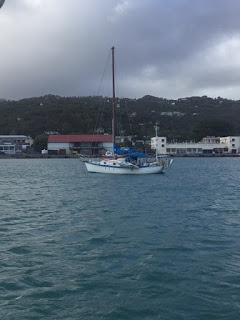
We are both now anchored in the sheltered Buffalo river, East London, wondering if we should bother putting our dinghies in. Apparently the yacht club is closed and town is an hour's uphill walk away.  Might just stay and do boat jobs.. got enough of everything for a few more days. And it's not unpleasant sitting on anchor.


Looks like a good weather window for the next overnighter to Port Elizabeth (145 miles) coming up on Saturday, before it turns to custard on Sunday. Fingers crossed ....


Stunning sunrise in the warm Indian Ocean.  You can just make out "Argonauta" in the distance.


Tuesday, 6 February 2018

The other Africa


Richards Bay, 7/2/2018
Dad’s big 100th birthday celebrations in NZ went off swimmingly. Quite literally in fact, as those of us able (or willing), joined him in the water for his daily swim. Very special!


Dinner at a local restaurant with about 30 close friends and family proceeded smoothly enough.  A few short speeches and Power point nostalgia were topped off by a catchy tune to “Dear Grandad Jack” written and performed by Misha and Sarah.


Thanks to all who made this occasion so special.
Moving on.....
After about 40 hours of flying backwards in time, I reboarded the patiently-waiting good ship Shanti in Richards Bay, South Africa. The whole trip took a lot out of me. Despite being wonderful, it still required major organising and dancing to different tunes than what I’m used to sailing solo. I still don’t feel as if my head’s quite on right. Somehow this interlude was a kind of demarcation, a time to reflect on what’s been and what’s ahead. Perhaps it’s a corollary of looking aging in the face.
Friday was a typical Sth African summer’s day, high humidity and temperatures topping 40. The Boardwalk mall seemed a good place to take shelter for a few hours and restock the empty fridge. From the street, the mall is a vast, grey, slab-sided monolith that appears to be set in several acres of wasteland and car parks. Inside, it is the same brightly lit, air conditioned spaciousness as found in any modern shopping centre. All the mega department stores, supermarkets, restaurants, book stores, toy shops, boutique fashion parlours, electronics stores, arcade gaming dens, all blaringly loud and glaringly seductive.
I needed a post office to return the door keys which I had inadvertently brought back with me from Melbourne.  Surely any self respecting modern shopping mall has a post office.  Surely not.
I was directed outside of the confines of coolness and took one of the corridor exits, stepping into what seemed like Dante’s Inferno. Crossing a narrow street it was as if I went back in time, entering what must have been the old shopping centre before it was plasticised. Suddenly I was shoulder to shoulder with hordes of dark skinned people swarming like flies in all directions. Those that were stationary were standing in long queues at the ubiquitous ATMs. Friday must be pay day.
When I finally found the well hidden PO I could scarcely believe my eyes: a queue as long as an international flight’s, with the same crowd-controlling belt barriers, winding back and forth, several layers deep. Surely this couldn’t simply be a post office?  A man was directing traffic, sending next in line to form shorter lines in front of each counter. There were about ten narrow counters, each positioned behind an old fashioned, timber-framed sash window. I half expected those serving to be wearing a green plastic visor and stretchy arm bands on long sleeved shirts.
And it was HOT.  No air conditioning in this antiquated building. Sweat dripped from every brow. I had no idea what they were all there for.  There was no sign of any mail being handled. In fact there was no sign of any prepaid post bags and I was starting to get worried that such things didn’t exist here.  But fortunately, half an hour’s melting later, my turn came and the large woman serving me disappeared out the back for no more than another ten minutes to locate such an uncommon request. Shoni, you should get your keys in another week or month....
On my way back to coolness I passed yet another thick queue, the longest and saddest yet, lining up before what was little more than a hole in the wall, with a handwritten sign for some government subsidised medications for long term communicable diseases.  This is the side of Africa I hadn’t yet encountered.
Yesterday I hauled out at Zululand YC on the club dolly to replace a broken seacock and through-hull skin fitting.  The hull was water blasted as well so is now barnacle free and looking tidy.  At $AU120 in and out, it’s got to be the cheapest place to lift out of the water in the world – naturally, it feels a little precarious, kind of like careening on wheels.

They do have a more expensive travel-lift which also uses the same concrete launching ramp at high tide. I had to wait for a deeper keeled yacht to be launched before me.  It was interesting to watch the yard boys jump overboard once they’d finished untying ropes.  Again, not something you’d see in Oz.
So now I’m almost ready to continue coastal hopping south.  The new stays which were sent up from Cape Town yesterday should be here tomorrow, that is, if the local version of “island time” doesn’t prevail. Clearing out takes a full day, so with any luck, I may be doing an overnighter the 90 miles to Durban by this Friday. Be good to go sailing again.


Thursday, 7 December 2017

Wildlife

South Africa, 7/12/2017

The combined wild life reserves of Hluhluwe (pronounced Shishluwee) and Imfolozi, are about the size of a small country, covering 96,000 hectares of bushland.  Being only 80 miles north of the marina at Richards Bay,  they are the closest parks and easiest to access in a self drive hire car.

I didn't want to go on my own, so asked the American father and son off the 27' yacht "Beguine" (who had helped with my damaged rigging back in Rodrigues) to join me, sharing costs of hire car etc.

I was the designated left hand driver, and they were my eyes as we crawled slowly along hundreds of miles of dirt tracks, looking this way and that, one of them occasionally calling "Stop!, back up, there! See it? A white rhino".


The white Rhino isn't actually white, but has some distinguishing features as well as a dusting of icing on its back.
Unbelievably, these huge creatures, bigger than a truck, can move a few feet, stand stock still behind a spindly patch of twigs and simply disappear from sight.  So you have to move slowly, stop often and be patient.

Then suddenly a 20' tall giraffe is standing in the middle of the road - 
 
 
then a mountain-sized elephant.


Totally surreal, almost as if sculptures in a Disneyland theme park, until they move.

I was blown  away by just how ginormous these animals are up close, out in the open.  At times I felt a little nervous, especially when they started walking our way.
We saw nearly all the Big 5 - the elephant, the rhino, (both, white and black), the water buffalo, the lion.  Only missed out on the leopard, but we did see a leopard tortoise.
 
A pride of lions, mother, father and cubs lazing about in the clearing. Binocs necessary to get a close up view.  About as close as I would want to be.


There were heaps of other impressive animals - 
 
This zebra stood in the middle of the road, stamping his hind leg.  Only after we passed did we notice he had no tail (most probably a snack for a lion), so was just keeping flies (not us) away.
 
 - wart hogs, impalas, wildebeests, baboons, hippos and Nile River crocs -


The two hippos on the left were about to fight (apparently to the death) over a female.


These delicate, frisky little Impalas were everywhere. I love the way they kick up their hind legs when bounding away.
 
The Beguine guys were seasoned bird watchers and spotted many vultures, eagles, buzzards, kingfishers and others. Again, binocular viewing only for the really big birds in the treetops.

The cost of the three day excursion was very inexpensive, with the hire car being only $AU20 a day. Accommodation in the nearby town of St Lucia (where we took the hippo and croc boat) was about $AU20 each for a two bedroomed self catered apartment.  
 
On the second night, we rented two twin bed chalets at $100 each inside the reserve, a bit more costly but well worth it. 
 
The Mpila camp in the  southern Imfolozi reserve is unfenced, so animals can wander freely through at night. Whoa. Didn't see any but heard plenty of velvet monkeys, baboons, and bigger? 
 
Of course I was nervous of there being boa constrictors or the like in the thatched roof, but luckily didn't see anything of that particular species.
 
We could have booked a tour jeep for minimal extra expense, but I think doing our own "hunting" was better.  I can just imagine bumping along on the bench seats in the back of one of these vehicles, amongst several other tourists. The tour guides use drones to find the animals, would drive you straight to them, stop a minute, saying, "there's a rhino"; "there's an elephant" etc. before moving on to the next.  Where's the challenge in that? 


Giraffe equivalent of a lolly-pop man at a school crossing; standing in the middle of the road while several smaller ones ambled slowly across.


Thursday, 30 November 2017

The "boring" passage to Sth Africa


Richards Bay, South Africa. 30/11/17

 
A good day on the Indian Ocean.

Departed Mauritius on the 11th Nov, anticipating two weeks of uneventful (even boring) sailing to South Africa - just for you, Alexa Bell.  Alas, it was not to be.

There were half a dozen other yachts on the same passage and I joined them on the SSB radio “Indian Ocean Crossing Mag Net”.  (You ham radio gents will be happy to know my signal was said to “boom out” loudest of all, and I was often called upon to relay for other boats.)

If nothing else, it let me know that I am not an orphan when it comes to boat problems.  Various common breakdowns assailed them, from autopilot to rig failure, to complete engine seizure. Eve, on “Auntie” had to turn back from almost halfway and bash against the wind back to Reunion with steering problems. Ouch.

The Indian Ocean is crowded with commercial shipping – Japanese, Maltese, Greek, Italian, Liberian,  – trading whatever from here to there and back again, because obviously whatever another country has must be better than what we have, but luckily they want that, so send their ships to get it.  It’s a curious and growing phenomenon.  What it means for small yachts is there’s more likely to be a watch  on the bridge whose awake and watching out.  A great many left a track detouring around Shanti.
 

The AIS has done for radar what the GPS did for the sextant – practically rendered it obsolete.  If not for me having a two-way AIS transceiver on board Shanti, which lets ships see me, I would have been squished like a bug on a windscreen so many times – well, I guess really only once.


The seabirds are so tame they will sit on my finger and land on my head. They come and go. How does a pea-brained bird know how to find Shanti again in a vast open ocean, to recognize her and return to their bidden nestling spot? One tried to commandeer the cockpit and pecked at my legs if I approached but I quickly put paid to that cheekiness and it settled in the crook of the dinghy tube.

 
There is a well-respected Sth African weather adviser, Des Casons, who guides his “chicks” safely in, or at least warns them of nastiness ahead. He tried his best to help me skirt an unexpected coastal low due to hit late Friday night, but in the end I just had to wear it.  He was spot on in regards to timing and position, but not quite in ferocity.

I have never seen anything quite like it before.  Probably the scariest part at first was the sheet lightning, which lit the entire seascape for miles every second and made me worry about my mast  being the tallest thing around.  Next came torrential rain, hammering like a billion stones on the cabin top.
Then the wind.  Within minutes it went from zero to over 40 knots. All hell broke loose.  I had to go out into the cockpit to deal with it, getting drenched to the skin and soon shivering with cold. Tilly, the autopilot squawked her refusal to deal with such demands, so I lashed the tiller and used the engine to hove to. 
The headsail sheets came loose and were flailing wildly about like demented snakes.  The sail unfurled a few feet, adding to the whip-cracking mayhem.  The whole boat was shaking violently. It was real seat of the pants flying, trying to comprehend the more urgent need and deal with it.
The starboard sheet was tightly tangled up with the flag halyard and other ropes, as well as having  knotted  itself into a rock hard monkey fist. Its outer casing was shredded and the sheet simply couldn’t be retrieved.
I managed to get the headsail winched back in and secured things as best I could.  In the midst of all of this the AIS alarm was going off, warning of at least half a dozen ships nearby.

Fortunately it didn’t last long and the wind abated to something sailable. In the pitch black night I had to go forward and run the port sheet over to the starboard side so I could use the headsail. 
By the time I hit the dreaded Agulhas current, the waves were high, with the southerly wind fighting against it.  It was a long slow bash to windward for the last 50 miles with the wind around 27-30 knots.

Never was I more relieved than to thread myself through all the ships and enter the channel into Richards Bay.
Never realized what a busy port Richards Bay is. One yacht had to stand off for 2 hours before being allowed in. The port is closed if wind gets over 40 knots so I was fortunate in making it.


I am now rafted up alongside a 52' UK yacht on the Q dock, with restaurants and suchlike a hop step away.  It is a well protected harbour within a harbour. Stillness!  What bliss.  
 
Apologies to those of you who were worried by my tardiness in posting a safe arrival blog but I have been in recovery mode, as well as busy booking flights out of here. Shanti will rest in the Tuzi Gazi marina for the next two months while I fly back to Oz and NZ to visit friends and family.

My reward for having successfully crossed the Indian Ocean is to go and see some big cats.


Wednesday, 8 November 2017

Dig deeper


Mauritius, 8/11/17

Yay!!  I made it to Mauritius!  A short hop of only 350 nautical miles, 3 days; nothing really.
But ...
That was definitely the most harrowing passage so far, with me so much on edge as to almost fall over the unseen precipice into the realm of chaotic confusion.


Waiting for something unknowably imminent to happen is perhaps one of life’s greatest stressors. All you know is it’s as inexorable as the next sunset, but you don’t know when or how or to what extent its impact will be.

After leaving the calm anchorage at Rodrigues with my patched up rig, the seas were short and steep and tumbling every which way, leading to a return of the good old “mal de mer” with me feeding the fishes for hours and feeling quite incapacitated.  I could hear the turnbuckles clanking against the chain plates and knew the rig was too loose but there was nothing I could do about it in my “just let me die now” state. At dawn the next morning I forced myself to go up on deck with screwdriver and shifter in hand.

A lot of this journey is to do with overcoming inner resistance, digging deeper than ever asked to before, seeking that extra ounce of fortitude that might still be in reserve.  There didn't feel like much left to prop me up, that's for sure. But that mast needed propping up.
In the milky morning light I could see the stays and mast swaying like strands of limp spaghetti. I tightened the stays up just enough to take out the slack.

Two days later, with a sharp gunshot crack, the windward lower shroud let go. It was a sound I had been dreading to hear.  I hadn't really expected it, believing those US engineers to have nailed it.  With 20:20 hindsight, some of what they did was questionable. 
But then I often trust others' opinions more than my own, especially the so-called experts of the world. Experts, someone since told me, are the very ones to be wary of, since they are expert in doing things in a certain way that they know, and may not be able to see beyond that.
But in that moment, I wasn't luxuriating in such ruminations.  Fear of the mast falling at any second overwhelmed me.  Would it hole the boat and she quickly sink? Would I be able to cut it away in time to prevent that?  I had heard of muscle-bound crew struggling with bolt cutters, hacksaws or grinders. All these thoughts flashed through my mind.  What to do, what to do?

Firstly stop panicking and mop up your tears. Take the one remaining halyard from the main and attach it to the port toe-rail. The mast was creaking and groaning like a haunted house.  I felt sure it would fall at any second.

I furled in most of the headsail and started the engine to motor the remaining 100 nautical miles to Mauritius.  I wasn’t sure if it was ok to do this, imagining the rigging getting tangled in the propeller if it fell.  My silent mantra became, “if it falls, quickly, instantly, immediately, urgently, throttle back to neutral.”

I couldn’t impress upon myself strongly enough the urgency of this; yet still it was amazing how often that thought vanished and needed to be reinstated. Such is the weakness of the mind. Or mine at least, in that time of mixed emotions, with moments of pending disaster interspersed with moments of tranquil acceptance.

It was a seemingly interminable 26 hours of roller coastering along, using every resource I had to visualise a safe arrival. The wind had dropped to around 18 knots and the sea state was the best it had been on this three day passage. Still, each oversized wave caused the mast to sway violently, lifting a good half inch off the deck. Amazingly, it was still standing as I motored into Port Louis in Mauritius. 

Tied up safely at the Customs wharf I surveyed the damage: the base of the mast had several small splits and one larger crack on the left. 

The whole mast had moved about half an inch to the right. Looking up it had a distinct S bend in it. I felt so despondent, as if I had worked so hard to save it but it was wrecked anyway. 


Later on it occurred to me that this was still a preferable outcome, since it could have caused a lot of other damage to the boat or me in falling, and I still had the boom, sails, wiring, lights, etc.

In Rodrigues I had been given the contact of a good rigger, famous Vendee Globe sailor, Herve Laurent, and this recommendation was confirmed by other cruisers in the usual marine equivalent of the good old Aussie bush telegraph.

They were not wrong.  Herve and his English speaking wife, Sophie, were standing dockside at the Caudan Marina on Sunday afternoon. They asked me my time frame and I half jokingly said two days.  It seems he took me literally, arriving early Monday morning, cannibalising old bits to make new. At the point where he loosened off all rigging to move the mast back into position, I couldn’t bring myself to watch so went shopping. Such a girl! 

Incredibly, two days later, I am patched up yet again and ready to continue.
A splint riveted across the crack and two bolts to help stop the mast from twisting.


They say that cruising is mainly about doing boat jobs in exotic locations – which sadly we often don’t get to see much of. This is true, not just of smaller, older boats but also the magnificent floating apartments, such as the 43’ Island Packet “Infanta” berthed behind me.


The owner is clearly no gentleman, sailing the wrong way round back home to Perth. He’s had engine overheating problems, water-maker failure, etc etc. Same same – only I don’t have most of his extras. But we’re all out here, facing similar challenges.
The sail training schooner, "Argo", circumnavigating with 32 young trainees, taking on 5,000 litres diesel this morning before heading to Sth Africa.
Next stop for me is also South Africa, either Richards Bay or Durban, depending on the wind.  Either way, it will be a grand moment to get there and be done with this wild Indian ocean, which incidentally, I have observed is the same colour as Indian ink, which perhaps was named after it?


Tuesday, 31 October 2017

USA engineers on the job.

1/11/2017, Rodrigues

There was only one other yacht in the "turning basin" anchorage when I arrived, a yacht even smaller than Shanti, which always makes me feel better about my diminutive size. "Beguine" is only 27' and is circumnavigating with father and son, Ron and Mark, from Florida. 


Fortunately for me, both are engineers with decades of experience of dealing with every conceivable problem that might beset anything. They are the kind of guys who once faced with a problem gnaw away at it until the best solution is found. And so they did for three days after looking up at the rat's nest of my unravelling rigging, each morning presenting me with different options to consider.  They were totally respectful and left it to me to accept or reject their ideas.

They came prepared with miles of rope, block and tackle for independent mast climbing.


We decided to hacksaw the T toggles off the upper ends of the stays, re-lay the unravelled wires, wrap something strong around the mast above the spreaders and join them together with D-clamps, or "bulldog" clamps.


The unravelling wires on the lower stays.


A lot of this kind of temporary fix depends on what's available.  Luckily there's a Chinese "hole in the wall" store in town, well hidden behind a steel red door, that seems to sell a mixed bag of everything, from eggs to hardware.

A couple of years ago, back in Melbourne, good friend Peter Dransfield was clearing out his garage and gave me some cables suitable for locking up a dinghy.  One of these was quite heavy duty, about two metres long with a swaged eye at each end.  

We stripped the PVC coasting off the end of the cable to attach the stays to.

Hacksawed in half and threaded through the eye it made a perfect sling for going diagonally above the spreaders. The cut off end of the stays could then be joined to this using the D-clamps.
It looks a bit like part of a shell necklace.


About an hour after finishing the job, the huge Canadian yacht "Dream Catcher" arrived.  Norm was glad to find nothing remaining to be done apart from giving it the thumbs up.  I was still very appreciative of their support all the way here, knowing they were only a few days behind me and ready to rescue me if needed.


Next morning, the other single handed female sailor, Eve, arrived on her beautiful US ketch "Auntie".


We leave today, me at 0900 for Mauritius, they at midday for La Reunion.  Ron and Mark, who have already been here 7 weeks, leave Friday for Durban.

With continuing good luck, I should find a competent rigger in Mauritius with all the necessary parts to replace our jury rig for something more permanent. Should be there by Saturday morning.....

Friday, 27 October 2017

Strong angels wanted.

Rodrigues,  27/10/2017

Someone recently said I have had more than my fair share of bad luck and the rest of this trip should be plain sailing.  What's that about tempting fate? 

Another unplanned detour, though not so far out of the way this time, was again thrust upon me by circumstances beyond my control - aren't they all?.  Here, in an unscheduled stop at Port Mathurin, Rodrigues, I'm only about 3 days short of my intended next port of Mauritius, but didn't want to push my luck with faulty rigging and potential dismasting.

What happened?  

Here's a suggestion from a friend of daughter, Pandora's, as to the potential inherent weakness in swaged wire terminals:

"The fraying stays are a worry, would be interested to know  what type of terminal fittings are on the boat and whether the standing rigging was recently done.  Generally it's not the wire rope that's the issue but the swaged terminals. I used to repair a lot of these in the shop and the swaging pressure used is critical to ensuring wire fibres are not crushed in the process."


The rigging was all replaced before leaving Melbourne, so only a couple of years old.

We did suffer a couple of knock downs and a great many hard hits that could have contributed, but it sounds more like this type of swaging is the problem, given that all three lowers failed.

I couldn't believe my eyes, when only a few days out of Cocos Keeling I looked up and saw a couple of shiny little curly "pig's tails" just below the spreaders.

At that stage I had joined a convoy of two German boats, who have been buddy boating for the past 10 years, standing 4 hour watches for each other, so one can sleep. Seemed like a great idea!  With me along, there was a potential 8 hours off.  


Klaus is an inspiration, at 80 years old.  He built this sturdy little craft that we have jokingly referred to as the lifeboat from the Titanic.  I say "little boat", but he is in fact one meter longer than Shanti and certainly did better in heavier weather, carrying much more sail than I can.

Once I discovered the rigging problem, I suggested they go on without me, as I would need to slow down and didn't want to hold them up.  They weren't quite as churlish as it seems in leaving me (had friends to meet in Reunion), but it was a wistful gaze at the diminishing white dots on the horizon that left me feeling very alone in this great big ocean with a mast that may soon be coming down round my ears.

Then it was back to setting my own watch keeping timer, either for 30 or 60 minute intervals, and at times I had to really force myself to get up.  Some self talk/pep talk in the wee hours:  "this is your job, it's only for a few days, make the most of the off times and go quickly back to sleep please".  Mostly I obeyed.

There were at least two ships I saw each night.  I wondered how many more I didn't see.

My attempts at supporting the mast involved using every halyard, wire, rope, dyneema, winch, jammer and cleat available.  At moments, I could even forget the imminent threat, relax and enjoy the sailing.  


At other moments, it was not so easy.


Just when I thought I was getting used to the constant motion and not knocking myself about as much, I took an unexpected tumble backwards against the stove and the little bolt thingies on the rails stabbed me hard on the spine.

Saturday 14/10,  I started packing an abandon ship bag.  With 1600 miles still to go there isn't a lot of choice other than to scuttle the boat, though I hate the thought of losing her for the sake of a few strands of wire.  I also hate the thought of having to climb a multi storied rope ladder up the sheer face of a passing tanker.

Each time I lay down to rest, another idea would spring to mind as to how to further reduce the risks, even if only to stop one of those needle sharp curly tails puncturing the dinghy.  So hop up again, and do more... this time, wrapped Velcro round the stay and used a "mouse" for a spare spinnaker halyard to pull it up and jam it tight.  That should help stop further unravelling, though I knew the weakness was at the swage.

After I had taken the baby stay to the windward side, and tightened up its turnbuckle as hard as I should, I was starting to feel a little more secure.  This light hearted moment passed a couple of days later when I noticed the leeward shroud starting the same tricks.  Switched the halyards to share the load.

With each passing day I grew more confident of making it to Mauritius.  Friends on a Canadian boat, Dream Catcher, were a few days behind me, so could pick me up if worst came to worst.  That was comforting to know.

When I gave my intentions of pushing through to Mauritius, Norm queried the sanity of this and encouraged me to stop at Rodrigues.  They are only about another 3-4 days behind me, so may be able to help with some further jury rig.  When my "main-stay", the windward baby stay snapped, it was decided!

As I write this, I am tied up alongside the main commercial wharf.  What a great relief!!  Have almost finished the clearing in process, have got internet, have made enquiries as to rigger, though, as suspected, drawn a blank there.

Luckily they didn't make me move for the departure of the Coast Guard ship.
 

Whenever a ship comes in, it's necessary to move from here, leave the port and turning basin, so it will be back out to sea for a bit this coming Sunday, the day Dream Catcher is due.  I sure hope Norm has something clever up his sleeve, or at least a mast rat capable of going up and reinforcing things aloft.  Then I suspect it will be a further limp to Mauritius. Time is against me, because of cyclone season starting mid November, so I mustn't dilly dally.

On a positive note, my power situation seems sorted.  With the solar panels charging the new batteries each day, I haven't had to run the engine at all.  And when I had to up anchor and come alongside the dock yesterday, the windlass worked like fury, with no tripping out, even against a 22 knot breeze.  Big thanks! 😊

And big thanks to all family and friends who offered concern, loving support, strong vibes and stronger mast supporting angels to help me through.


Sent from my iPad