Thursday, 26 April 2018

Solitude and Soliloquy


Jacare, Cabedelo, Brazil, 26/4/2018


The evening before departing St Helena, a fellow cruiser from Namibia incited me to lunacy, climbing the 690 near vertical steps of Jacob’s Ladder. Given that it was to be the last serious exercise I’d get for the next 3 weeks, it wasn’t a bad thing.


Most other yachts had already left the moorings, so again, I was a tail runner, on my own. For the first time, I really felt this solitude, perhaps exacerbated by the lengthy calms and slow progress. This must be the “gentleman’s” Atlantic I had heard about.


The first week out, the wind teased me with fluctuations between 2 knots and 20 knots. On day 3, after the frustrations of chasing its every nuance, I overcame my apathy and dug out the spinnaker from under the V berth up in the bow. Wasn’t exactly sure what I was going to do with it, as I had never even seen it, never mind flown it before.


It took a good 2 hours to unearth it, work it out and set it up, but boy, was it worth it! With 6 – 8 knots of wind from behind, boat speed got up between 3 – 4 knots. I realized it was going to be a long, slow passage. The 100 nM days I was used to were to be a thing of the past; I was lucky to see 70 or 80 at best.


A beautiful sight to behold.


The kite can only be used running “square” or with wind dead astern, and not at night, in case of wind increase, which did seem to happen a lot, so I was always glad to have doused it at dusk.


I am beginning to learn the subtle shifts in wind and wave directions with wind tending more E in the day and more SE at night. The waves are often larger than the wind would suggest, indicating stronger blows further away, or coming. There is always a garland of puffy white clouds around the rim of my world and often thick black storm cells which suck the wind out before belching it back violently. This is almost like the doldrums, though not usually found so far south of the equator.


0330, day 5, saw Shanti totally becalmed. I ran the engine for a few hours, with the thought of hoisting the kite at dawn. At 0830, there was not enough wind even for this. I was stalled. This had the potential of being a peaceful experience, were I able to accept it.


It was to become something of a recurring theme. Wind here; wind gone.  I thought the open sea was supposed to be constant and consistent Trade winds, for weeks on end. Again, not on my crossing.


I made the mistake of plotting waypoints on my course - lots of them! It was almost depressing to see the number of potential days inching or millimetering across the map. With no idea of what winds I might get, this really was the unanswerable question of how long is a piece of string? It could be 3 weeks; it could be a month (I didn’t like to even entertain the thought of more than that). It “should” be 18 days. Hah!


Back in Port Elizabeth, a Frenchman told of having to hand steer for 70 days after his autopilot failed. He “parked” each night to sleep, dropping all sails and leaving his boat to drift (and roll), not always in calm conditions like I was in.


Shanti rolled, so much so that I opted to set a tiny amount of sail, (to avoid that dreadful slatting), and try to hold my course, even if only making 1knot.


At 0350 I was woken by a male voice calling “Hey Twinkle, Twinkle! Sue!”  I leapt up expecting to see someone nearby who had obviously mistaken Shanti for another boat, but of course no-one was there. The wind had increased to 18 knots, so I happily put up more sail and began moving in earnest.


I have observed in many other cruisers this need to get there, and preferably asap. This is a common human trait that reflects an uneasy relationship with the present, an expectation that “there” will be better than “here”. There is a tendency to keep looking toward the future, a fantasy, which only exists in the mind, stealing the richness of what is here and now.


I started watching my mind more closely and found my thoughts are runaway trains, creating a weirdly entertaining, yet unreal world. It’s a bit like that line in the song: “everywhere you go, you always take the weather with you.”  What’s inside projects onto the outer screen.


Attitude is everything.  If I lament my slow progress, I can make it much harder on myself than if I turn my attention instead to the here and now – the sounds of water gurgling past the hull, the wind - the strength of which I can tell pretty accurately now by the pitch of its hum.


I know I WILL get there. When? is becoming less important.


The beginning of week 3 saw some steadier 10-12 knot winds.  With only the poled out headsail I was able to run pretty well downwind, gybing the pole only twice a day, morning and evening, a tricky enough manoeuvre on my own.


I find it is a very humbling experience, being out here alone on the sea. Some friends have expected me to feel proud of what I have achieved so far, but I don’t. Sure I have the sailing skills, or at least enough so far to keep me out of too much trouble.  Sure I have the tenacity and perseverance to push on through the testing times.  I am pig-headed and determined enough to refuse (so far) to quit.


But the enormity of the ocean, which has the power to squish me like an ant, prevents anything but gratitude to it for not having (yet) done so. The magnitude of the heavens, stars, planets and galaxies that enthral me at night, shrink me to less than a molecule of dust. I feel it is a great privilege to be able to be out here.


On two occasions, when there has been a gap in the ring of cloud, I have seen the elusive “green flash” at sunset.  What a thrill! (No picture of this unicorn sorry; way too fleeting.)


Similarly (but differently) exciting are the flying fish.  What on earth inspired these bizarrely  prehistoric creatures to take to the air – to leave their first medium, water, for another?  Perhaps some predator was sizing them up for breakfast, chasing them faster than they could run, and suddenly, they take to the sky, skimming above the waves, their gossamer wings beating madly, only barely keeping them aloft, their tail trailing like a rudder, then sploosh! a head-on crash into a wave, but farther from danger.  Crazy critters – they always make me laugh out loud!


Such a shame a few gasp their last on Shanti’s deck.  I wouldn’t have thought they could fly that high, but some have even made it into the boom bag or whacked me in the face at night. 


As the coast of Brazil and the end of this stage drew nearer, I was in no hurry to get there. I had broken through that sense of urgency and was happily enjoying “Groundhog day”. The flat disc of sea stretching all round, the curved dome of sky above, with only tiny Shanti, day after day in the same apparent spot, as if pinned to the exact centre, a visual solipsism. The relative position never changes, never gets further from one horizon or closer to the other.  Always the same, dead centre.


With not another living soul in sight for weeks on end, just me, encapsulated in this tiny space, like an interstellar life-support pod (only at times, buffeted more boisterously) I greatly appreciate this rare opportunity, away from distractions of people and things. It detangles brain cells, reassembles in a new and wondrous way the kaleidoscope of a lifetime of esoteric rabbit holes I have been down.


Two days out from Cabedelo, I looked up and noticed the mast head light fitting was dangling like a broken marionette on a wire. Either a big-footed booby bird had tried to dance on it, or the rigger back in Cape Town didn’t secure it well (I notice my first reaction is blame). 
Notice also flying the Brazilian courtesy flag and yellow Q (Quarantine) flag


The eventual fall from grace came the night before my approach to land (no navigation lights), but the good fortune within the misfortune was that it didn’t plop straight overboard (which by all accounts it should have) but hit the deck and was still there on arrival, albeit in many pieces.


Morning glimpse of Brazilian coast; skyscrapers look like overcrowded, jagged teeth.


Jacare Yacht Village is about 8 miles up a river. Its bushy banks and murky waters give the feel of going up the Amazon (not that I ever have) and it’s a surprise when at the turn of a bend there is a modern-ish marina, and not too far away, the bustle of a busy metropolis, Joao Pessoa (which is probably the jagged teeth seen from offshore).
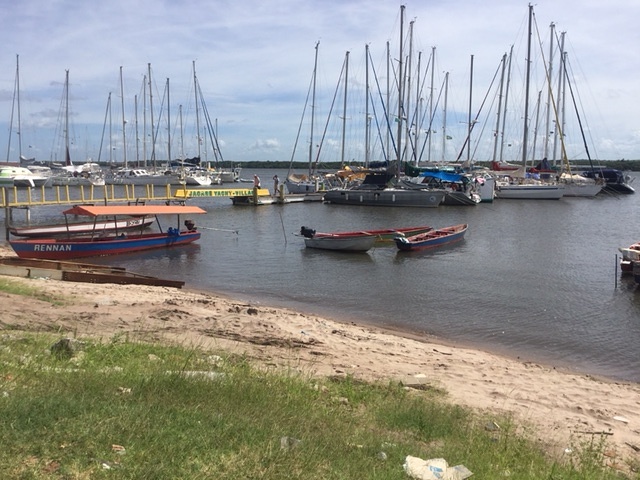
Jacare marina just like Bundaberg Port, apart from colourful local craft in foreground.


Yesterday, the entire day was devoted to long walks and bus rides to do the usual check-in procedures of Immigration, Customs and Port Captain.  It would have helped had I spent more time learning a few more words of Spanish (here they speak Portuguese, which is similar, and very little English.)


The weather was kind to me for my arrival, calm and sunny; the day after, (yesterday) the skies opened up to dump a deluge of tropical rain with strong winds. I was lucky also that some fellow cruisers invited me to raft up against their boat until the marina office was able to allocate me a berth. The boats are packed in side by side, with no walkways in between, using laid lines from behind to hold them back from the dock. In other ways, it’s similar to Bundaberg, being in a fast flowing tidal river.


It feels very odd to be still, almost as if on concrete, (I don’t think I’m in the mud at low tide) after the constant motion of the past weeks.


I plan to stay here a week or two to get some much-needed sleep, R & R and consider the next leg, most likely up to Trinidad.


Happy Anzac day to those in that realm.

Sunday, 1 April 2018

The South Atlantic

St Helena, Easter


Whoever said the Atlantic Ocean is a “gentleman’s ocean”, with steady 15 knot SE trade winds obviously went on a different day to me.


The first few days after leaving Cape Town involved several hours of motoring through the calm patches. There were also moments of the most beautiful sailing I’ve ever had on the open sea, with 8 knots on the beam, sunshine and very little swell. This turned out to be the calm before the storm.


Three days later I was in huge seas, up around 6 metres, wind 35 plus. It was a wild slalom ride, slewing off to left and right, gybing at the bottom of each wave as poor Tilly (tillerpilot) struggled to hold course, no matter how many degrees off I gave her.  Every few waves one would slam violently against the hull like hitting a brick wall. 


Torrents of water doused the entire boat, cascading through the middle hatch over me in my bunk.  The forward hatch might just as well not be there.  Everything was soaking wet.


Worst of all is the Sadler design feature/flaw of the “bathtub” stowage area under the cockpit floor which lets a bathtub full of sea into the boat at every slam dunk or broach.  The bilge pump can’t deal with it as water sloshes from side to side up the walls. The floorboards are awash and of course, everything is on the floor.


A side swipe from one of those Mach trucks bursts open locker hatches and all contents go flying.  Butternut pumpkin missiles are lethal.


Three times the wild ocean tried to claim the blue canvas lee cloths from the sides of the cockpit, as well as the newly side-mounted solar panel. On each occasion, I heard a thunderous wave approaching; nothing I could do but hang on tight and get soaked to the skin.


I felt at a very low ebb, having little sleep or food for three long days and nights.


Here is my “Perfect Recipe for Sleepless Night”:


“Add 35 knots to 5 m swell to choppy top layer. Mix on minimum drive power and equal parts of slalom slew.  Stir well, trying to keep upright. Watch for excess froth and bubble, followed by collapse, then sudden and violent alternation.”


This could also be called “Gybing the night away”.


Gybing bunks.


I don’t recall it being quite so harsh in the Indian Ocean, but then, bad memories fade as the sun comes out.


The1800 nautical miles from Cape Town to St Helena took 17 days. The wind continued to be fickle, ranging from 5 knots to 30 knots. The last 48 hours were the deadest calm, with not a breath of air to ruffle the sails.  It was fortunate that this total becalming happened at the end of the passage, and not the middle, so I could burn the rest of my small reserve of diesel to motor in.


There is nothing quite so surreal as the sight of a lump of rock rising out of an empty ocean in the pre-dawn light.


The positive side of this lull is that the mooring field at St Helena is relatively quiet.  I heard that a couple of weeks ago it had a 3 metre swell upsetting everyone. Then they “close” the harbour.


Going ashore is challenge enough in good weather, and impossible in rough. A robust little wooden ferry offers a commuter service for GBP2. The surge sometimes drowns the concrete landing, which has ropes to assist the leap ashore.
(Had a good pic of this, but internet is very limited here).


The town itself has a quaint, olde worlde charm, with beautifully preserved historical buildings clinging to its steep slopes. A British colony, with around 4,500 residents, everyone is super friendly and helpful. It is Easter now, and the whole island has gone camping. Some fellow cruisers and I are hiring a car to explore further afield.


The interior is a constantly changing landscape, from barren, windswept rock, to verdant fields and cool canopies of dense forest. We visited the blighted, narrow strip of airfield, ending abruptly at the edge of a sheer precipice, built on the most turbulent side of the island and subject to much criticism, but providing a necessary link with the world.


Also the house where Napoleon was exiled and tomb where his body once lay before being taken back to France. All in all, a fascinating bastion.
Happy Easter All from Shanti, St Helena.


Sunday, 11 March 2018

Cape Town Catchup


Cape Town, 11/3/201
But first, one step back ..

Port Elizabeth
NO, it's not Shanti.

The Algoa Bay yacht club marina in Port Elizabeth has got to win first prize for being the marina most likely to be condemned.  Apparently a gale almost destroyed it in 2009 and they have been (slowly) rebuilding it ever since.  Such projects have low priority in South Africa. 

The mega money spinner here is the adjacent manganese ore terminal, which doesn’t help matters in the marina, where nothing is spared its sticky grey dust. So the handful of sadly neglected boats left to rot here wear this added coat of dismal despair. Even the fierce south-easterlies can’t blow them clean; only threaten to blow them and their fragile pontoons away, which is why they use so many dock lines, which is probably a bit of an oxymoron.


Despite this, the locals made Port Elizabeth one of the friendliest stopovers I have encountered.


From there, fellow cruisers, Sheri and Giorgio, on Argonauta encouraged me to alter my plans to stop at 3 or 4 more ports along the coast and take the 4 day weather window directly to Cape Town.  It turned out to be a wise call. (as mentioned in my last mailout).


Since arriving in Cape Town on 23rd February, there has been good news x 3 and bad news x 3 (so we’re sitting on about par).

The good news #1 was an electrician came to Shanti and (finally) wired in the “Sterling Power Advanced 4 step Programmable Universal Digital Alternator Regulator” that I have been carting around with me for many months.  Hopefully this will solve all my engine running/battery charging problems. Good news #1a is that he only charged me R600.  I spoiled it for everyone else by giving him 700.

Good news #2 is I received a very valuable letter of introduction to the Royal Cape Yacht Club from my home club of Sandringham.  This reciprocal clubs’ benefit drops my marina fees from R280 to R78 per day (divide by approx 10 for $AU).

Bad news #1 is that my Volvo Penta “dripless” shaft seal has been not just dripping but spraying many litres of sea water into the bilges. The passage from Port Elizabeth had me bailing out a bucketful every few hours. This will necessitate hauling Shanti out of the water (again) to replace it.  Wish I’d known about it back in Richards Bay.

Cape Town takes the appellation of ‘windy city’ to new heights, with fierce katabatics (or bullets) blasting gaping great holes in the air, funnelling wind sheer to a toppling  assault. 

It’s never easy to arrange things around it.  Once the thick white banks of cloud blanket the magnificent Table Mountain like sheets of snowdrift, you know that wind is coming.


In the marina, it was howling all night long, all the halyards on nearby boats whipping and slapping on the masts, and even wrapping round their neighbour’s VHF antenna.. look closely at the end of this video clip.


The crane was booked for 0900 on Monday 5th, but the wind was blowing the crabs off the rocks, so it was cancelled.  A couple of hours later, in a slight lull, they were able to lift me.


Flying Shanti

Bad news #2 – to remove the old seal, the shaft has to be separated from the coupling that connects it to the gearbox. Naturally the very rusty old bolts have not seen light of day for aeons and refuse to let go of their solidified attachments. With loads of not so gentle persuasion and a trip to the machine shop, problem solved.
Dripless shaft seal being replaced from the grubby, seldom visited end of the engine.


Good news #3 is that my mast was removed without drama last Friday and they were able to do a relatively inexpensive weld repair to the base, which was not just cracked but snapped right through, so very good news that I am in the right place for the job, the home town of Sadler 32’s and Shanti’s birth place, where they even have a custom cradle for Sadlers.


Mast was cracked on the outside and completely broken on the inside.

New sections welded in and reinforcing sleeves on the outside. Even spray painted this bit, so it looks like new.


Bad news #3 is that after lifting me out, the hook of the crane caught under one of the solar panels, breaking the glass.


A few days later this became good news #3a.  I now have 2 new panels which actually fit better than the old ones and I retrofitted the one surviving panel to the side of the boat.  This gives me 400W of potential energy from the sun, with a maximum peak efficiency of around 15Ah input, in a perfect world, with strong sunshine, at midday on the equator – perhaps half that in the real world, so no problem using the existing 20A solar regulator.  Who knows, I may even be able to run a fridge now? Woo hoo!  All power to Shanti.


I have been very impressed with the workmanship here and the costs, which are about half what they are in Australia. So if you can’t make it to SE Asia for cheap boat works, come to South Africa for your next refit.

Jobs completed in the past 3 weeks include the mast and rigging repair, rewiring it through a new, hopefully leak-proof gooseneck, new reef lines (from Southern Ropes where they sell extremely cheap offcuts by weight), new Volvo dripless shaft seal, new solar panels, and best of all, 4 new 100Ah deep cycle batteries, delivered to the boat. 

I bit the bullet on this one, even though I had only put two new non deep cycle, Calcium batteries on a few weeks ago in Durban.  I didn’t want to risk mixing different types of batteries; having 4 the same has been something I’ve wanted for years.  Putting it in perspective, they cost the same as one week’s stopover in my next stop at St Helena. Putting it another way, they may just help get me to St Helena.

The old corroded (leaking) aluminium window frames were removed and new timber frames made instead.  They look great and hopefully are one more move in the direction of a dry interior.


New ply frames look fantastic.


Other good stuff has been taking time out to “smell the roses”, thanks to the Argonauta’s and their friends, who have made excellent tour organisers. Up at “sparrow’s ...” saw us off on the first red bus, touring the city, bays, coastline and of course wineries. I think I disappointed a few of the sommeliers by spitting most of my half-glasses out (isn’t that what the spittoon is for?) but still ended up feeling languid as a limp lettuce leaf at the end of the day.
Sheri & Giorgio from Argonauta share a few tastings at Groot Constantia winery.


Probably the worst news is nothing to do with Shanti or my small problems, but all to do with the recalcitrant rain gods, who haven’t opened the skies in over 3 years.
Cape Town is on Level 6 water restrictions, with rations of 50 litres per person per day. (I could give lessons in Shanti-board minimal consumption of 2-3 litres per day, but of course I have access to salt water, especially since I replaced my electric galley pump with a decent (read, working) one). The marina taps are turned on for one hour, 3 times a week, and of course, no washing boats down, so Shanti is pretty grubby from tradies' hob-nailed boots.

Toilets are all fitted with dispensers of hand sanitizers instead of soap (the suppliers of this must be making a killing!) and things like swimming pools, laundromats, car wash places, etc. are out of business. It is the most talked about topic here, with forecasts of reservoirs running dry in a few months. The hierarchy of disaster is first the land, then the plants, the animals, then the poor people. There’s a lot of tension in the air and people speak of corrupt governments and mismanagement, but those things are not new here. Only the drought adds its punch.
Despite this, the locals have been incredibly friendly and helpful to me, leaving me with a very positive impression of Cape Town.

I took the 45 minute walk this morning to the local produce market via the upbeat V & A waterfront marina with Sheri and Giorgio. It was one of the better markets I’ve seen, with heaps of gourmet edibles, making me wish I’d gone on an empty belly.  I filled my shopping jeep with last minute fresh goods, like unripe tomatoes and bananas, home-made cheeses (hope the fridge plays along), non-sulphur dried fruits and nuts.

From there it was to the Ports, Immigration and Customs and I am now officially checked out of the country.  Funny how you can wander about freely with your passport stamped out.

From here to St Helena is about 1800 nautical miles, so there’ll be nothing heard from the Shanti  blogspot for a few weeks. The weather looks about as good as it gets on this coast, with light winds to begin with, which should send me off on a good start.  After that .... it’s anyone’s guess....


Thursday, 15 February 2018

Back to Eating the Elephant

East London, 16/2/2018


Two phrases I have mentioned before, “eating the elephant” and “coastal hopping” have raised their cheery heads again. Sailing around the southern coast of South Africa, Cape Agulhas and Cape of Good Hope, also known as the "Cape of Storms", is mostly done in small bites, involving at least 6 or 7 stopovers along the way. Perhaps one is never done with these.


From Richards Bay to Cape Town is over 1000 nautical miles and the timing for each bite is entirely determined by the weather.  At least once or twice a week the strong SW’erlies blow, which is not a good time to be out there. The wonderfully helpful Agulhas current runs southwesterly at up to 6 knots, but whenever it meets one of these opposing winds, waves can build up to 20 m high, terrifyingly described as being able to snap the back of massive tankers in half.


Weather watching takes on a whole new meaning. Enter the wonderful ex cruiser, Des Casons, who provides his weather services free - this year, to 64 of his “chicks”.  His response to my enquiry was, “it would be unconscionable to abandon the last of my  “chicks” as the rest with two exceptions are all safe in Cape Town, and some already over the pond in S America.”


The two tail runners, Shanti and Argonauta have the advantage of Des’ undivided attention, as well as less crowded marinas.  It’s good to be sailing in company with one other boat, even though at 44’ she is much faster than Shanti. An interesting couple, she Canadian and he Italian, though I have to confess to understanding barely half of what he says.  Still, it’s good to share the bureaucratic nonsense that must be gone through at each port with reams of documentation describing some oft repeated “flight plan”.  At least it’s all free, apart from shoe leather and time, which is not in short supply.


Several of the earlier fleet had to bypass Durban after it was closed due to storm damage.  That made their first bite a big one, 360nm from Richards Bay to East London. So I was glad to make my first overnighter only 90 miles. It was a boisterous sail with winds up to 30 knots and lumpy seas, and I was pleased to keep my insides in.


There was still evidence of the damage to the floating pontoons in Durban Marina, as well as no power or water.  Not a bother at all; I was just glad to find shelter and rest.


It’s little wonder these marinas fall apart so easily.  They might just as well be held together with string and chewing gum, the way they are anchored with rusty chains to the seabed. When the wind blows hard, it’s a symphony in motion, with moored boats and pontoons swaying together.


Some boats have had to wait several weeks for the next suitable weather window, so we were glad to be given the thumbs up by Des in only 3 days.  Gave us just enough time to do all we had to do and to meet up with the "saint" himself for beer and brunch.  I had 2 new batteries “home delivered” to the boat which was an amazing service.


After running around to all the usual rubber-stampers - Marina office, Ports, Immigration, Customs, then back to Ports and to the Marina office (anyone would think we were leaving the country), we were ready to cast off by 1100. The next hop to East London is 260 nm, which takes about 46 hours, with speeds up to 9 kts in the current.  There was very little wind so lots of diesel burning for the first 24 hours, but a nasty washing machine sea with waves coming from all directions.


There were a few dramas en route. Argonauta’s engine overheated a couple of times, she blew a water cooling hose, and had some other weird “explosion” in the engine room that blackened the ceiling. Luckily for them, the wind arrived in time for them to sail. (they are, after all, a yacht.)


It was the opposite on Shanti.  I got all excited about having 4 batteries to play with, so ran my fridge and everything else all night, completely forgetting that the alternator still doesn’t charge 4 batteries any better than it doesn’t charge 2.  (Must get that fixed in Cape Town).


When a usable wind finally kicked in at 2300,  I turned off the engine. Horror of horrors, all my power went off. No lights, no autopilot, nothing!  I ended up having to idle the engine the rest of the way. (I am yacht after all, but that engine has uses other than propulsion.)


We both arrived at 0630, only to be told we had to stand off and wait 3 hours for shipping.  Aaaahhh!  The wind was forecast to come in strongly at 0900 and already the sea and current were messing us about. Argonauta was told to drop their anchor (in 46 metres, hmmm, not long before that was dragging) and Shanti was running out of fuel. What a fiasco. 


Eventually they took pity on us. A disabled tanker was asked to anchor off, two tug boats towed Argonauta in, and Shanti just made it in under her own steam.


These bulk car carriers look more like Lego blocks than ships.


We are both now anchored in the sheltered Buffalo river, East London, wondering if we should bother putting our dinghies in. Apparently the yacht club is closed and town is an hour's uphill walk away.  Might just stay and do boat jobs.. got enough of everything for a few more days. And it's not unpleasant sitting on anchor.


Looks like a good weather window for the next overnighter to Port Elizabeth (145 miles) coming up on Saturday, before it turns to custard on Sunday. Fingers crossed ....


Stunning sunrise in the warm Indian Ocean.  You can just make out "Argonauta" in the distance.


Tuesday, 6 February 2018

The other Africa


Richards Bay, 7/2/2018
Dad’s big 100th birthday celebrations in NZ went off swimmingly. Quite literally in fact, as those of us able (or willing), joined him in the water for his daily swim. Very special!


Dinner at a local restaurant with about 30 close friends and family proceeded smoothly enough.  A few short speeches and Power point nostalgia were topped off by a catchy tune to “Dear Grandad Jack” written and performed by Misha and Sarah.


Thanks to all who made this occasion so special.
Moving on.....
After about 40 hours of flying backwards in time, I reboarded the patiently-waiting good ship Shanti in Richards Bay, South Africa. The whole trip took a lot out of me. Despite being wonderful, it still required major organising and dancing to different tunes than what I’m used to sailing solo. I still don’t feel as if my head’s quite on right. Somehow this interlude was a kind of demarcation, a time to reflect on what’s been and what’s ahead. Perhaps it’s a corollary of looking aging in the face.
Friday was a typical Sth African summer’s day, high humidity and temperatures topping 40. The Boardwalk mall seemed a good place to take shelter for a few hours and restock the empty fridge. From the street, the mall is a vast, grey, slab-sided monolith that appears to be set in several acres of wasteland and car parks. Inside, it is the same brightly lit, air conditioned spaciousness as found in any modern shopping centre. All the mega department stores, supermarkets, restaurants, book stores, toy shops, boutique fashion parlours, electronics stores, arcade gaming dens, all blaringly loud and glaringly seductive.
I needed a post office to return the door keys which I had inadvertently brought back with me from Melbourne.  Surely any self respecting modern shopping mall has a post office.  Surely not.
I was directed outside of the confines of coolness and took one of the corridor exits, stepping into what seemed like Dante’s Inferno. Crossing a narrow street it was as if I went back in time, entering what must have been the old shopping centre before it was plasticised. Suddenly I was shoulder to shoulder with hordes of dark skinned people swarming like flies in all directions. Those that were stationary were standing in long queues at the ubiquitous ATMs. Friday must be pay day.
When I finally found the well hidden PO I could scarcely believe my eyes: a queue as long as an international flight’s, with the same crowd-controlling belt barriers, winding back and forth, several layers deep. Surely this couldn’t simply be a post office?  A man was directing traffic, sending next in line to form shorter lines in front of each counter. There were about ten narrow counters, each positioned behind an old fashioned, timber-framed sash window. I half expected those serving to be wearing a green plastic visor and stretchy arm bands on long sleeved shirts.
And it was HOT.  No air conditioning in this antiquated building. Sweat dripped from every brow. I had no idea what they were all there for.  There was no sign of any mail being handled. In fact there was no sign of any prepaid post bags and I was starting to get worried that such things didn’t exist here.  But fortunately, half an hour’s melting later, my turn came and the large woman serving me disappeared out the back for no more than another ten minutes to locate such an uncommon request. Shoni, you should get your keys in another week or month....
On my way back to coolness I passed yet another thick queue, the longest and saddest yet, lining up before what was little more than a hole in the wall, with a handwritten sign for some government subsidised medications for long term communicable diseases.  This is the side of Africa I hadn’t yet encountered.
Yesterday I hauled out at Zululand YC on the club dolly to replace a broken seacock and through-hull skin fitting.  The hull was water blasted as well so is now barnacle free and looking tidy.  At $AU120 in and out, it’s got to be the cheapest place to lift out of the water in the world – naturally, it feels a little precarious, kind of like careening on wheels.

They do have a more expensive travel-lift which also uses the same concrete launching ramp at high tide. I had to wait for a deeper keeled yacht to be launched before me.  It was interesting to watch the yard boys jump overboard once they’d finished untying ropes.  Again, not something you’d see in Oz.
So now I’m almost ready to continue coastal hopping south.  The new stays which were sent up from Cape Town yesterday should be here tomorrow, that is, if the local version of “island time” doesn’t prevail. Clearing out takes a full day, so with any luck, I may be doing an overnighter the 90 miles to Durban by this Friday. Be good to go sailing again.


Thursday, 7 December 2017

Wildlife

South Africa, 7/12/2017

The combined wild life reserves of Hluhluwe (pronounced Shishluwee) and Imfolozi, are about the size of a small country, covering 96,000 hectares of bushland.  Being only 80 miles north of the marina at Richards Bay,  they are the closest parks and easiest to access in a self drive hire car.

I didn't want to go on my own, so asked the American father and son off the 27' yacht "Beguine" (who had helped with my damaged rigging back in Rodrigues) to join me, sharing costs of hire car etc.

I was the designated left hand driver, and they were my eyes as we crawled slowly along hundreds of miles of dirt tracks, looking this way and that, one of them occasionally calling "Stop!, back up, there! See it? A white rhino".


The white Rhino isn't actually white, but has some distinguishing features as well as a dusting of icing on its back.
Unbelievably, these huge creatures, bigger than a truck, can move a few feet, stand stock still behind a spindly patch of twigs and simply disappear from sight.  So you have to move slowly, stop often and be patient.

Then suddenly a 20' tall giraffe is standing in the middle of the road - 
 
 
then a mountain-sized elephant.


Totally surreal, almost as if sculptures in a Disneyland theme park, until they move.

I was blown  away by just how ginormous these animals are up close, out in the open.  At times I felt a little nervous, especially when they started walking our way.
We saw nearly all the Big 5 - the elephant, the rhino, (both, white and black), the water buffalo, the lion.  Only missed out on the leopard, but we did see a leopard tortoise.
 
A pride of lions, mother, father and cubs lazing about in the clearing. Binocs necessary to get a close up view.  About as close as I would want to be.


There were heaps of other impressive animals - 
 
This zebra stood in the middle of the road, stamping his hind leg.  Only after we passed did we notice he had no tail (most probably a snack for a lion), so was just keeping flies (not us) away.
 
 - wart hogs, impalas, wildebeests, baboons, hippos and Nile River crocs -


The two hippos on the left were about to fight (apparently to the death) over a female.


These delicate, frisky little Impalas were everywhere. I love the way they kick up their hind legs when bounding away.
 
The Beguine guys were seasoned bird watchers and spotted many vultures, eagles, buzzards, kingfishers and others. Again, binocular viewing only for the really big birds in the treetops.

The cost of the three day excursion was very inexpensive, with the hire car being only $AU20 a day. Accommodation in the nearby town of St Lucia (where we took the hippo and croc boat) was about $AU20 each for a two bedroomed self catered apartment.  
 
On the second night, we rented two twin bed chalets at $100 each inside the reserve, a bit more costly but well worth it. 
 
The Mpila camp in the  southern Imfolozi reserve is unfenced, so animals can wander freely through at night. Whoa. Didn't see any but heard plenty of velvet monkeys, baboons, and bigger? 
 
Of course I was nervous of there being boa constrictors or the like in the thatched roof, but luckily didn't see anything of that particular species.
 
We could have booked a tour jeep for minimal extra expense, but I think doing our own "hunting" was better.  I can just imagine bumping along on the bench seats in the back of one of these vehicles, amongst several other tourists. The tour guides use drones to find the animals, would drive you straight to them, stop a minute, saying, "there's a rhino"; "there's an elephant" etc. before moving on to the next.  Where's the challenge in that? 


Giraffe equivalent of a lolly-pop man at a school crossing; standing in the middle of the road while several smaller ones ambled slowly across.


Thursday, 30 November 2017

The "boring" passage to Sth Africa


Richards Bay, South Africa. 30/11/17

 
A good day on the Indian Ocean.

Departed Mauritius on the 11th Nov, anticipating two weeks of uneventful (even boring) sailing to South Africa - just for you, Alexa Bell.  Alas, it was not to be.

There were half a dozen other yachts on the same passage and I joined them on the SSB radio “Indian Ocean Crossing Mag Net”.  (You ham radio gents will be happy to know my signal was said to “boom out” loudest of all, and I was often called upon to relay for other boats.)

If nothing else, it let me know that I am not an orphan when it comes to boat problems.  Various common breakdowns assailed them, from autopilot to rig failure, to complete engine seizure. Eve, on “Auntie” had to turn back from almost halfway and bash against the wind back to Reunion with steering problems. Ouch.

The Indian Ocean is crowded with commercial shipping – Japanese, Maltese, Greek, Italian, Liberian,  – trading whatever from here to there and back again, because obviously whatever another country has must be better than what we have, but luckily they want that, so send their ships to get it.  It’s a curious and growing phenomenon.  What it means for small yachts is there’s more likely to be a watch  on the bridge whose awake and watching out.  A great many left a track detouring around Shanti.
 

The AIS has done for radar what the GPS did for the sextant – practically rendered it obsolete.  If not for me having a two-way AIS transceiver on board Shanti, which lets ships see me, I would have been squished like a bug on a windscreen so many times – well, I guess really only once.


The seabirds are so tame they will sit on my finger and land on my head. They come and go. How does a pea-brained bird know how to find Shanti again in a vast open ocean, to recognize her and return to their bidden nestling spot? One tried to commandeer the cockpit and pecked at my legs if I approached but I quickly put paid to that cheekiness and it settled in the crook of the dinghy tube.

 
There is a well-respected Sth African weather adviser, Des Casons, who guides his “chicks” safely in, or at least warns them of nastiness ahead. He tried his best to help me skirt an unexpected coastal low due to hit late Friday night, but in the end I just had to wear it.  He was spot on in regards to timing and position, but not quite in ferocity.

I have never seen anything quite like it before.  Probably the scariest part at first was the sheet lightning, which lit the entire seascape for miles every second and made me worry about my mast  being the tallest thing around.  Next came torrential rain, hammering like a billion stones on the cabin top.
Then the wind.  Within minutes it went from zero to over 40 knots. All hell broke loose.  I had to go out into the cockpit to deal with it, getting drenched to the skin and soon shivering with cold. Tilly, the autopilot squawked her refusal to deal with such demands, so I lashed the tiller and used the engine to hove to. 
The headsail sheets came loose and were flailing wildly about like demented snakes.  The sail unfurled a few feet, adding to the whip-cracking mayhem.  The whole boat was shaking violently. It was real seat of the pants flying, trying to comprehend the more urgent need and deal with it.
The starboard sheet was tightly tangled up with the flag halyard and other ropes, as well as having  knotted  itself into a rock hard monkey fist. Its outer casing was shredded and the sheet simply couldn’t be retrieved.
I managed to get the headsail winched back in and secured things as best I could.  In the midst of all of this the AIS alarm was going off, warning of at least half a dozen ships nearby.

Fortunately it didn’t last long and the wind abated to something sailable. In the pitch black night I had to go forward and run the port sheet over to the starboard side so I could use the headsail. 
By the time I hit the dreaded Agulhas current, the waves were high, with the southerly wind fighting against it.  It was a long slow bash to windward for the last 50 miles with the wind around 27-30 knots.

Never was I more relieved than to thread myself through all the ships and enter the channel into Richards Bay.
Never realized what a busy port Richards Bay is. One yacht had to stand off for 2 hours before being allowed in. The port is closed if wind gets over 40 knots so I was fortunate in making it.


I am now rafted up alongside a 52' UK yacht on the Q dock, with restaurants and suchlike a hop step away.  It is a well protected harbour within a harbour. Stillness!  What bliss.  
 
Apologies to those of you who were worried by my tardiness in posting a safe arrival blog but I have been in recovery mode, as well as busy booking flights out of here. Shanti will rest in the Tuzi Gazi marina for the next two months while I fly back to Oz and NZ to visit friends and family.

My reward for having successfully crossed the Indian Ocean is to go and see some big cats.