Thursday, 6 June 2019

The pressures of home


Savusavu, Fiji, 6/6/2019

Returning to Shanti is usually a great pleasure, but this time I felt quite low. The brief interlude spent with family and friends in Melbourne had zoomed by without time to catch up with everyone, but it was enough to fill me with the warmth of those near and dear, and the sudden contrast of being completely alone again weighed heavier than ever before.

It was obvious to me what had happened. I had spent the previous 49 days and nights alone at sea on that interminable passage from Panama to Tahiti, arrived exhausted, and before my feet had steadied on the land, had immediately jumped on a plane home. There had been no time to establish contact with even one friendly face, and now I had returned to that void.

But it wasn’t time to linger. I needed to do what had to be done and get moving again. Mat, the local rigger, arrived more or less as arranged and replaced the lower shrouds. He did a good job and I was glad I hadn’t waited for the replacements to be sent from Cape town, or I’d still be waiting.
I collected my duty free alcohol (Absolut vodka at $US6 a bottle, and likewise quality French wines) and walked to Carrefour for the last time to spend the last of my francs. Peculiarly for me, I used them to buy a new dress instead of more provisions. (Perhaps the influence of shore life, where shorts and T shirts don’t constitute every day attire.)


It was 1530 before I finally got away and the fading hours of daylight were spent motoring in a windless rolling swell. After clearing the island’s wind shadow a strong Sou’easterly soon had me reefing down. These were the first few days of 25-30 knots that I was counting on to get me off to a flying start. A 75 mg capsule of Stugeron held my queasiness at bay, but still it was an uncomfortable first night and I couldn’t relax.


Seeing the bunches of black clouds rimming the horizon put the panic in me, remembering the last beating one had dealt. I dropped the main entirely and furled to a pocket handkerchief of headsail in readiness, and was glad I had. The Society Islands of Bora Bora and Raiatea are well known for these squalls. As the rain began pelting down and the violent gusts tossed Shanti like a toy, it was back to hanging on till it passed.

The frequency of these storm cells make it prudent to remain reefed down, and when they pass, Shanti is left wallowing, with sails slatting noisily in 3 or 4 knots of wind. Storm cells are like giant vacuums that suck up the air from all around, gathering it into a concentrated blast, then laughing at the upturned turtle left floundering helplessly in its passing shadow.

A few bright lights on the shore prick the darkness as the landlubbers settle into their evening with family, safe and sound within their solid shelters, and I am struck by a deep loneliness. Such is the price of having split my journey to go home for a few weeks, just long enough to get a taste of that warmth and to miss it so much more deeply.

The rest of the night and all of the next day continued with much of the same, wearing me down lower than any other time before. Perhaps it’s because I know I’m on the home leg now, and a part of me just wants to get there. I don’t have a lot of interest in sight-seeing in foreign ports.
“What’s the good of being alone in paradise?” someone once asked me. This feeling is exacerbated by having spent such a joyous time with a handful of other cruisers in the Caribbean, and now, since transiting the Panama Canal, I find myself completely alone again.

Day 4, I woke up to relative quiet, no sails slatting, no rolling or lurching, and clear blue skies with 12 knots of breeze just aft of the beam; in short, a glorious morning, with Shanti gliding along as if on a well oiled track.

Is there some kind of predetermined trade-off of a gorgeous day for a lousy night? The entire rim of the horizon was on fire with a shimmering white glow, occasionally shot through with staccato orange and red flares, as if some angry god was hurling fireballs into the sea.

I want to curl up and hide under my bunk, only the ship’s stores are already cowering there. I managed to get a few hours’ rest, but by dawn the wind had completely gone. The big black cumulo-nimbus encircling Shanti had sucked it up again, so I resigned myself to a few more hours motoring in a rolly sea.

Funny how quickly things change. By 1400 I was punching into a steady 12 knots right on the nose, punctuated by 20 knots in the squalls. By 1600 I gave up on that pointless, fuel burning exercise, cut Yani, and bore away to sail due north. It was boisterous sailing, only slightly disheartening that it was entirely in the wrong direction. The DTG was 270 nM, the calculation was 9 days. “More like never, heading off in this way!”

By 1900, the wind had dropped back down to 4 knots, so I decided to hove to for the night. This can be quite a peaceful thing and well worth doing when in need of sleep. I only got up a couple of times, more by habit, to check on things.


But having stopped is good psychologically, because it mentally prepares me for an extra day or two, or however many it takes, with the understanding that it can be just as pleasant out at sea as in a harbour. Hoving-to is kind of like anchoring in the middle of the ocean, sans anchor.


Despite the slow progress, and having to hove-to twice more, it was a relatively good passage of 12 days to cover the 850 nautical miles from Tahiti to the Northern Cook Island of Suwarrow, which was as glorious as I'd been led to believe.


Palm trees equal Paradise
I hadn't expected there to be any other yachts in the anchorage so was pleasantly surprised to find 3 others, 2 French and 1 German. The older Frenchman who had been cruising for 25 years said it was the first time he had encountered 4 single-handers in the one bay together. His boom was broken in half so he needed to leave the next day for repairs in Samoa. He was replaced by 3 men aboard a large Swiss-flagged catamaran, the owner, delivery skipper and one crew. We shared a few drinks, meals, laughter, stories, guitar-playing and singing in the Rangers' shelter each evening, which was just what the doctor ordered for me!  And plenty of practice for my French.


The general preference was to head to Western Samoa rather than American, it being less costly, less bureaucratic and a better anchorage, so I followed suit, to discover a different kind of paradise, but still enchanting.


The resort spa where we stopped for lunch; same palm trees, different vibe.
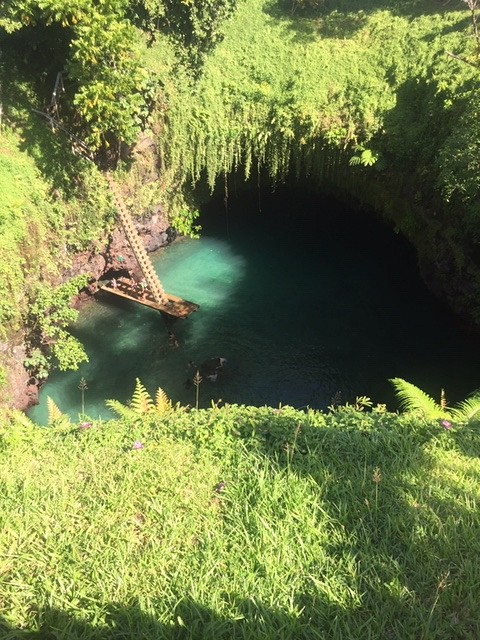
 A few of us took a taxi tour of the island, which included stops to swim in a waterfall pool and a deep ocean trench formed by a collapsed volcanic caldera, which was the highlight of the day.


My stay in Samoa was cut short by a panic call from my sister in Kalgoorlie, who was sure our father was on death's doorstep. After several phone calls back and forth to her, and to my dad and his wife Tanya in NZ, things didn't seem quite so bad, but still worrying enough for me to get moving.
I had already been intending to leave Shanti in Fiji and fly back to Melbourne for an excision of a small BCC from my nose, so it seemed prudent to head that way asap.
 
The distance of 580 nautical miles was covered in one week, with perhaps the best SE Trade winds sailing I have had for a long time.


I was very fortunate to get the last berth at the Copra Shed Marina, thanks to Aussies, Sally and Stuart on "Blithe Spirit" - the 46' yacht next to Shanti, recently arrived from NZ. It's amazing how small the cruising community is. I met this couple several years ago in the Whitsundays and it was an unbelievable coincidence that they should happen to be here at the same time as I. We went to a few local restaurants together in the 4 days of overlap, before they headed off today to cruise the more remote Fijian islands.


A chipped filling in one of my heavily filled molars sent me off to the dental clinic at the local hospital this morning.

The "waiting room" at the dental clinic this morning.
After all of this, things are still somewhat uncertain, and the "waiting game" continues.


In regards to my next moves, it's a bit of a we'll see, or to cite one of my favourite sayings, "all will become clear in the fullness of time".


Hoping life is treating you all as gently as a smooth technician....


Tuesday, 26 March 2019

Panama to Tahiti in only 49 days


Tahiti, 25/3/2019


Crossing half of the Pacific Ocean in one go was never my intention, but, as always, Nature dictates, and I merely follow. In my last blog, I mentioned the possibility of being 2 -3 months at sea, but I think I was secretly hoping that was an exaggeration.


As it transpired, it took exactly 7 weeks, or 49 days and 49 nights (just to make the point that I didn’t sleep through half of it) to do the 5,000 nautical mile passage from Panama to Tahiti - which is not too shabby really, making the customary average of 100 miles a day.


So how did it go? Mostly, frustratingly. Two things contributed to this – one, it was a bit early in the year so the Trade winds hadn’t fully developed, and two, the El Nino influence meant lighter winds in general, with the occasional reversal of direction. Nooo! Well, yes – I saw far more days with northerlies, northeasterlies, and even, in the last week, northwesterlies and southwesterlies. So much for the SE Trades!


I left Las Perlas on the 2nd February, bound for Gambier Islands in French Polynesia, 4,000 miles away. It began as it was to end – motoring. Of course it’s not possible to “drive” that distance, with a tank of only 70 litres of diesel, plus another 80 in jerry cans.


So a lot of demands were made on me to use what little wind there was and keep the boat moving. This was to become my mantra – just keep the boat moving – no matter how slowly. And only turn the key when actually stopped – assuming of course there’s still some fuel left.


On day 2, I had 18 – 20 knots of wind, dead astern. It was a beautiful day with the Las Perlas pelican convoys paragliding en masse. A perfectly proportioned, solitary dolphin arced across the bow, always a good omen. That night I set my timer for 30 minute intervals but didn’t get any sleep, there being plenty of fishing boats and ships around. Despite the slow start I covered 115 nautical miles in 24 hours. It helped enormously to have up to 2 knots of current with me.


My best day’s run on the passage was 133; my worst, 60, at which stage both wind and current had gone.


By day 4, the wind had dropped to 8 knots and I had the kite (spinnaker) flying. Thanks for the courage to try, the energy to dig it out from under the V berth, and the memory how. It was to become my best ally over the next few weeks. 


Initially I used the smaller “ whisker pole”, but eventually had to muscle up to manhandle the big pole - not so easy on one’s own (nothing is).


Over the next few days a new danger appeared – massive cut logs, presumably fallen off a ship, still with big metal staples in them. The fifth one passed within a metre of Shanti – about 2 metre diameter and 10 metres long, with a forked branch of similar size, which could easily have been a game ender.


The price of sleep is high. I lay down for a half hour nap on day 6, only to wake to blissful silence. The kite (which I never leave unattended) had an almighty “wine glass” wrap around the furled headsail. I started the engine and drove slowly round in circles to unwrap it.


Day 7, a very special occasion – once again, crossing the Equator. Back into the South Pacific. It was a magnificent sunny day and Shanti was slipping along smoothly. Party time!  A few South Pacific dolphins joined in. I did the laundry and had a salt water shower with fresh water rinse; put on my best dress, made a Pina Colada, listened to David Isom’s music, sang and danced. Topped it all with fresh home made bread and cheese. Perfect.


Three white birds, amazingly iridescent, lit up as if in a night club, stayed with me all night. They match the glistening phosphorescence in the water.


On Day 9, I was approaching Jimmy Cornell’s “exclusion zone” where others have reported adverse conditions. Do I avoid it, at cost of an extra day, or take my chances and blunder on through?


A couple of large Galapagian Booby birds have made their roost on my pulpit. I guess they know to avoid the rear solar panels, (usually a favourite) as Blewy made mince meat of some poor hitchhiker a few days ago. Just left a few feathers and visceral smear as a deterrent.


Don't know if these hitchhikers had their sights set on Australia.


Sadly I had to evict the squatters on Day 11.  They squawked in loud protest as the spinnaker billowed toward them. They may return later, or find another free ride to wherever.


I don’t know if I was feeling bad about evicting the birds, but for some reason I was having more trouble than usual with the kite. I noticed one of the birds circling Shanti and lining up for a landing. Coming in on a perfect windward approach, she made it, only to have a sudden flap of the kite scare her off. This was repeated three times and it seemed as if she had no intention of giving up.

Just then, on her third landing, the spinnaker halyard gave way at the top of the mast, and the whole kit and caboodle fell into the water. I could hardly believe my eyes, but was very glad to have been watching as it happened.  I raced forward and began grabbing great handfuls of the waterlogged cloth, pulling it back on board before it disappeared any further under the boat. I couldn’t believe the weight of it, especially the fibreglass yoke of the still scrunched up sock.  Another pair of hands at this point would have been very welcome.


All the while, Madam Booby sat watching from her undisturbed perch, as if saying, “well, glad that’s out of the way.”


Poled out headie worked almost as well as the spinnaker.


I had some land-based weather watchers, Mark Goodall in Queensland, Pandora Hope and Andrew Watkins at the Bureau of Meteorology in Melbourne, and John and Becca on the yacht “Halcyon”. All advised heading further north to avoid a “dead patch” en route to Gambiers, so sadly, that destination was missed.


None saw anything untoward in the near future (I think weather forecasting is a bit like soothsaying of the past), so I sailed blithely into a huge electrical storm.  Around midnight I woke to torrential rain and Tilly 2 squawking her resignation. Just as I stumbled into the cockpit to relieve her, lightning lit the entire world around me and the deepest, most visceral boom of thunder shook me to the core. The word scary is a gross understatement.


I won’t continue with a blow by blow account of the entire journey (those interested can wait for the book.)


Suffice it to say, I was to experience several more of these storm cells interspersed amongst the calms over the next few weeks, the last being two nights before arriving in Tahiti. I had been watching the thick black clouds and dark curtains to the horizon, wondering what it might bring, when it suddenly hit with full force. Winds well over 35 knots, driving rain and the same terrifying lightning and thunder. I took the helm and ran with it for several miles due south, before realizing I was going with it, at which point I hove to until it passed. Then I had 2 knots of wind. There was nothing for it but to turn the key again and motor continuously the last 24 hours in to port.


I had already motored all the way through the low lying atolls of the Tuamotus, so was getting low on fuel. I spent a lot of time doing ridiculous calculations, which at the end of the day meant nothing.


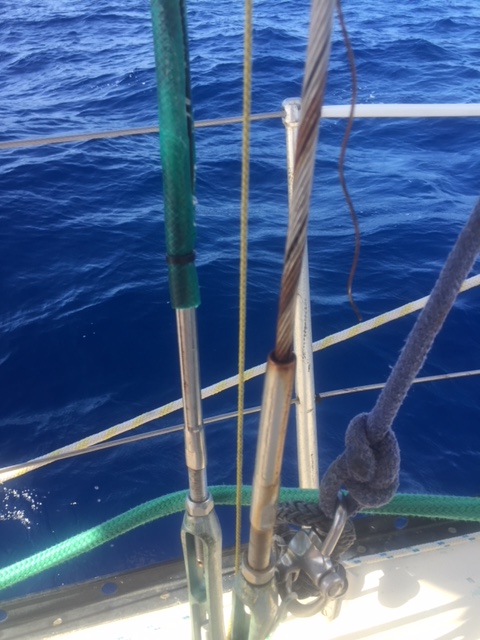
On two occasions earlier on, I had attempted to change course for the Marquesas, but again, was thwarted by the wind having other ideas. It was just as well, because a few days later I noticed my rig failing, again. The new lower shrouds, which had been replaced in Cape Town, were rusting badly at the base, where they are swaged to the rigging screw. I hadn’t taken too much notice of this, until I saw one of the wires actually break and begin its curly pig’s tail unwinding. Ai yai yai. Not again!


Luckily, this break was at the bottom, not the top, so I could get some clamps on it.


Everything was conspiring to direct me directly to Tahiti. Well, it was certainly an interesting challenge, spending that much time alone at sea. I’m still not sure what it’s done to my head. I guess the main thing I’ve learnt is patience and acceptance of what is. It all takes as long as it takes, and lady luck has a big hand in it.


I was certainly lucky in regards to breakages, compared to some. Apart from the shrouds and spinnaker halyard, the cheek block on the side of the cockpit (that the headsail sheet runs through) sheared off with an explosive crack. Also Blewy has become decidedly unbalanced since munching a bird, causing the targa, bimini and solar panels to vibrate wildly whenever there’s the odd burst of wind. But the main things – sails, engine, autopilot, Shanti, me – held together, and the food, water and fuel proved sufficient.
Approaching the passé de Papeete entailed circling around waiting for various ships to come and go; likewise transiting the several airport runways which cross over the inner lagoon, only this time waiting for planes, not ships. All rather nerve-wracking, exacerbated by not having slept for the previous two nights. Port Control would call me and say you have 5 minutes to get past the next runway, but with her barnacle-encrusted hull, Shanti was moving very slowly.


A pleasant swim for me each day, scraping these suckers off.


When I finally dropped anchor (for the third time, in an approved, not-too-deep, nor too protected spot) I felt absolutely done for. I arrived with about 5 litres of diesel left, about 50 litres of water, and half a pumpkin. Plenty of pulses, so it’s lentils again.


My  fresh produce lasted surprisingly well for about 3 weeks. After that, pulses, dahl, beans, chickpeas or lentils formed the basis of most meals, the pressure cooker being invaluable for this. I grew sprouts of various kinds, made yoghurt and bread. I developed a routine of cooking every second day, which gave me a break from the rocking, lurching, bucking galley. My body is a gymbal and quite adept at keeping plates of food and cups of drink on the level – mostly.


Communications became my greatest concern, as the Inmarsat Satphone and Spot Tracker both failed to connect to satellites for about the last 2-3 weeks. It made me feel very vulnerable, having no way of contacting anyone if anything (other than a total sinking) went wrong. The solitude I didn’t mind.


On Saturday 23rd March, after not having seen a soul for 7 weeks, I woke to the mayhem of an outrigger canoe paddling regatta, with literally hundreds of people all round me. Fortunately none wanted to chat.


April is a big month in Melbourne, with a few birthdays, Shoni’s PhD completion, and Misha’s headlining gigs, so Shanti will get to rest in Taina Marina here in Papeete, while I fly back home for a month to see family and friends. Hope to see some of you soon.


Shanti over and out.....

Tuesday, 29 January 2019

Panama Canal Transit

 January 29th, 2019, Pacific Ocean


Lifetime Panama Canal Ship ID for Shanti


Yet again, plans are as fluid as water. A few moments before my volunteer linehandlers arrived, the agent appeared on the dock to tell me my transit had been rescheduled for the following day.  At first this seemed a low blow, but good came of it, providing a day off, to relax by the pool and get to know one another.


It’s necessary to have 4 linehandlers on board and my agent was providing two men, at $100 each. Cruisers often help each other transit just for the experience and I found two extras through the Panama Cruisers Facebook page. Rachel and her husband Josh have their own boat on the Pacific side of the canal, in the newly opened Vista Mar marina. At first they were both coming, but Josh was busy preparing their boat for the South Pacific, so we became an “all girl” crew with the substitution of their good friend, Becca, a highly qualified young lady with her 100 ton Captain’s licence. They both proved to be exceptional women and great company. Another huge benefit was their willingness to help in the galley.


The meals I had precooked moved into another boat’s freezer (thanks Craig and Julie). The girls and I had Pina Coladas and pizzas at the marina restaurant that evening and they got to sleep for two nights on board Shanti instead of one.


On Thursday 24th, at midday, the two hired hands, Leroy and Jackson arrived, and I fed everyone some lunch before heading out to the “flats” to await our Advisor. The 60’ yacht, “Sauvage” that we were to transit alongside was already anchored there. The next few hours were the beginning of the waiting game. I was impressed with Leroy and Jackson’s ability to intersperse periods of dozing with sudden springing to action.


At 1630, a large black Pilot vessel approached, looking for all the world like it was going to plough us down, but stopped within inches to allow our Advisor, Edward, to step nimbly aboard. They sure know how to manoeuvre those powerful beasts incredibly skilfully; it’s almost as if the vessels are fitted with those electronic sensors that cars have to warn when you’re about to run over the neighbour’s dog.


Action stations! Start the engine, lift the anchor and begin heading towards the entrance to the locks, about 7 miles away. We are scheduled to transit the first three Gatun locks at 1800, following a very rusty looking ship that was anchored on the other side of the channel. Edward kept us informed of its movements (or lack thereof).


This is where confusion comes in. After gunning the engine full tilt to cover the distance, we find ourselves stuck in a “holding pattern” near the lock entrance for a couple of hours, just driving slowly round in circles, while two other tankers proceed before us. Nobody knows why.


Finally we spot “our ship” coming and it’s time to raft up (tie alongside) our buddy boat,  “Sauvage”. Her skipper approaches Shanti painfully slowly and I wish we were doing it the other way round, with Shanti using them as the moving dock. There are plenty of hands, and fenders, and even though one of their crew accidentally lets our stern line slip, with much yelling, and the next monster ship is blasting us to get out of its way, we finally proceed as one, into the lock.


The “uplocks” are vast empty chambers, waiting to be filled with 101,000  cubic metres, or 26.7 million gallons of fresh water to lift us about 10 metres to the next lock. The turbulence of this rapid inflow is huge, swirling around us like rapids. It’s a very weird sight looking back at the lights of Colon from our new height.


At 60’, “Sauvage” is big enough to take all four lines from both sides of her bows and stern, so nothing is required of us; we will just be dragged through like a limpet alongside.


This is where further confusion arises. Our rusty ship has a large tugboat behind it, tied up against the starboard wall, which for some unknown reason, we were expected to tie to. Hence there are no lines being thrown to our port side; in other words, nothing to stop Shanti from getting ever nearer the 30’ high concrete wall to our right. Again, much yelling, before in the nick of time we are secured.


The system is very human dependent. Four men, looking like little Lego men, way up high above us on the top edge of the lock throw the “monkey fists” at us. These are heavy balls of woven twine with metal centres that carry the thin “trace” lines, hopefully avoiding windows, hatches, solar panels, wind generators, and people. I was glad they were primarily being aimed at “Sauvage”, although we did have to transfer a couple that didn’t quite make the distance.


The linehandlers on board their boat then have to speedily tie these to the heavy 140’ dock lines they have prepared, laying them out carefully without twists or tangles. These are thrown overboard and the Lego men above pull them up and secure them to a bollard at the top of the lock.  The people on the boat take up the slack, constantly monitoring the change in tension as the water rises. It’s a demanding job. I watched a very muscle-bound woman next door frantically working to free some tangles, as if trying to detach a determined boa constrictor.


Fortunately, the monkey fists are only thrown once for the first of the three Gatun locks. Having risen to the top, the massive gates in front are opened, the heavy ropes are dropped back to us and we motor through, with the Lego men walking quickly along the wall with the trace lines in tow.  All rather remarkable, and generally proceeding smoothly, contrary to all the horror stories I heard beforehand.


After passing through the third lock, we entered Lake Gatun, where we were to spend the night. Unusually, we remained “nested” against “Sauvage”, who dragged us speedily through the darkness. Using powerful rabbit-blinder torches they managed to spot one of the giant round buoys to tie up to. The two yachts stayed snugged up together, which made for some uncomfortable rolling and jerking as ships continued to transit the lake all night long. Leroy and Jackson slept out in the cockpit and luckily it didn’t rain.


Normally, there are different Advisors each day, but to our pleasure, we had Edward again, who returned at 0830 on Friday, ready to go. He brought a big black plastic bag full of ice to cool the dozens of bottles of water and soft drinks that I was required to provide. Scrambled eggs and croissants were eaten under way thanks to my wonderful female crew, who handled that side of things fantastically.


One of my greatest stresses now faced me; could Shanti with her small engine and extra load of 6 bods keep up in motoring across the lake? I had deliberately avoided filling the extra jerry cans of diesel and water tanks to keep the weight off. (Once anchored safely on the Pacific side we ran out of water so we drank beer and rum instead.)


Our appointed ship was due to follow us into the Pedro Miguel “downlock” at 1330, which was 30 miles away. Leaving at 0830 gave us 5 hours to get there, which meant averaging 6 knots of boat speed across the lake; a very big ask. I was pleased to find that “Janis”, the trusty little Yanmar was capable of around 5.7 knots, but it was not enough. I had visions of living the rest of my days stuck in Lake Gatun. The two Advisors had already agreed that the bigger yacht would peg back its speed and wait for us.


That didn’t happen. Quite early in the route, they passed us and slowly pulled away. Very disheartening. Edward’s two main comments were, “Can you go any faster?” and “Move further over to the edge of the channel.” Neither was particularly helpful. I wasn’t prepared to risk total engine failure for the sake of a bit more speed nor running aground on the rocks that were within spitting distance in places.


I thought we made pretty good time, but as our ship passed us I asked Edward if they knew they were supposed to be locking with us. His reply was, “they don’t care.” He said we would just have to wait for another ship to go through with. Luckily a massive car carrier was fast approaching, so without missing a beat, we drove straight into the Pedro Miguel lock in front of it.


We spotted our non-buddy boat, “Sauvage” in the adjacent lock, tied alongside a small passenger ship. The girls made a few saucy comments, but really were glad to be on red alert, ready to test their knot tying skills. The monkey fists were thrown, the first one missed completely and landed in the water, the next one wrapped itself several times around the stays, the next one hit the aluminium bottom of the upturned dinghy on the foredeck with a percussive diiinngg. One of them Rachel caught perfectly, to much cheering.


This process had to be done twice for this set of locks as there is a longer distance between the first and second, so more monkey fist missiles came hurtling at us, but all were fielded beautifully. Go girls!

If anything is going to go wrong, they say it will be in the Miraflores, where the current swirls and gushes incredibly strongly, as if in a rush to reach the Pacific. It pinned the rudder hard across, almost forcing the tiller from my hands.


As we descended, I looked up at the sheer black walls of the 100 year old concrete sides of the lock, marvelling at the engineering of those times and considering the enormous cost in human lives to build this mighty canal. About 40 ships pass through every day; Edward told us it costs close to a million US dollars per ship to transit, which made my paltry 2 grand seem very reasonable.


Taking a moment to reflect on all this, I noticed that the trace line from my port stern was caught on one of the bollards recessed into the sides of the wall. The linesman above could not see this. I pointed it out to Edward, who told me not to worry, they would free it.


So the bells ring, the massive lock gates in front of us open, the current swirls and pushes us forward, the line handlers above release the lines – and, sure enough, one is caught. The ship behind us begins to move and Edward tells me to go. But how? We are still tied to the wall.


Well, I need not embellish the panic and confusion that ensued, with Rachel telling us to take deep “Yoga breaths” and stay calm. Easily said when about to be squished like a bug by a Goliath.


It was her line that was caught, and much as the guy on top of the wall flicked and whipped, it stayed caught. As we moved forward, she played out more and more of the heavy line that we still had onboard, fully prepared to lose the whole lot if necessary, rather than see Shanti pulled back against the wall, or worse still, run over by the ship. Of course the ship wouldn’t be happy to tangle our rope round his prop, so it was good that she didn’t have to.


Eventually, after what seemed like several lifetimes, the little Lego man above had the good sense to let go of his end. It could still have been wrapped too tightly to release, or gotten stuck with the monkey fist, but praise all the powers that be, it slipped free, trailing in the water behind us. Hallelujah!


Following this adrenaline spike, we were fast approaching the gates of the final lock, with only one stern line. These are the most important lines to hold us back, so it was a mad scramble to tie the jettisoned line onto the bow line and send it back up to be reattached and secured. Again, Rachel did a sterling job of this, while I had the engine in hard reverse.


As they say, it will all be alright in the end, and if it’s not alright, it’s not the end. We managed to avoid all the hard concrete and steel bits; nothing got broken, no one was hurt, and in the end, it was all alright, with a story to tell.


We crossed under the iconic Bridge of Americas, and we were in the Pacific, with its 5 – 6 metre tides!!!! So much stress and SO thrilled to have made it.


Cheers bigears!


With seamless precision, our trusty Advisor was picked up shortly after, followed by a taxi boat to take the ropes, fenders, and excellent linehandlers, Leroy and Jackson. The girls and I continued on alone to anchor off La Playita for an “arrival survival” drink, to unwind, laugh, chat and debrief. Then they left via the dinghy of friends anchored nearby and caught a cab back to their own boats and husbands.

Track from the Atlantic to the Pacific

The girls set up three GoPro cameras on board to capture the action, so I have plenty of memory joggers for my dotage.


I slept the sleep of the dead, woke early and set sail to Vista Mar marina, to refuel, put on more water and provisions in readiness for the next big hop. The really great thing was I arrived in time to phone my father in NZ for his 101st birthday on the 28th January.


Vista Mar: just like being at Mackay with tall piles to handle the big tides.

Tomorrow morning I head out into the Pacific, with a brief stop at Las Perlas islands before the 4,000 mile crossing to Gambier Islands. This will be the longest leg I have ever done and I’m hoping I have enough food and water for what could be 2 – 3 months, depending on how long it takes to get through the doldrums. So don’t expect any more blog updates for a while.


Wishing everyone all good things, with much excitement tempered by deep tranquillity.

Tuesday, 22 January 2019

Pacific Ocean Eve


Panama, 22/1/2019

Cruising “plans” are perhaps the most flexible of all plans, and where and when we go is pretty much dictated by the weather. Spotting a break in the perpetually strong winds we’d been having, I made the short dash across from Bonaire to Curacao on Boxing Day.


Curacao is a Dutch offshoot of Holland in the Lesser Antilles, a vibrant city with that typical Caribbean variety of colour splashed about.


I anchored in a wonderfully protected anchorage, Spanish Waters, about ten miles from the capital of Willemstad. A great many yachts shelter here in this hurricane free area.


Flanked by wealthy Venezuelan homes, an ongoing battle of fireworks’ displays lit the skies every night. New Year’s Eve was more of a crescendo than a finale with the horizon ablaze. Accustomed as we are in well-regulated Australia to seeing organised foci of fireworks, it was incredible to see such a wild profusion of brilliantly coloured explosives all around.


On the Queen Emma floating pontoon bridge.

It’s fantastic the way fellow cruisers make you instantly welcome, so I had good company for New Year’s, firstly taking the bus into town, then later sharing some music-making on board a neighbouring yacht until the wee hours.
Wonderfully hospitable hosts on sailing vessel "Dee"


As mentioned in my previous post, my original intention was to visit all 3 of the ABC’s, the next island being Aruba. From there, my course was set for Santa Marta in Colombia, then the San Blas islands before arriving in Panama.
But, as mentioned, weather is the boss. Advice from others who had been before me, warned me of the brutal winds and waves that are common in the Colombian basin, with many saying they faced the scariest conditions of their entire sailing lives. I wasn’t keen on putting Shanti (or me) there, so I watched the forecasts closely for a good weather window.


To go directly to Panama was about 750 nautical miles, about a week of sailing for me. It seemed a shame to miss out on seeing those other places, but there was also the fact that a couple of large rallies were hot on my heels, which would clog up the works in Panama.


I think I prayed too hard for calms because that’s what I got for the first few days, but after that, it was back up to 30 plus knots, which is still a lot better than 50 or 60. The main problem is the waves, which with strong wind against an opposing current can build up to over 4 metres high.

So it did end up taking me the full week to reach Panama and I was pretty tired. There was a lot of shipping and one cut within metres right in front of me, which was completely unnecessary.


I also had a repeat failure of the fitting that "Tilly" the autopilot attaches to, so had to do a fair bit of hand-steering.
Nursing Tilly home.


I had been told that there could be a 4-6 week wait to transit the canal at this time of year. Indeed, with each passing day, the delays increase, so it was fortunate that I arrived when I did, on January 15th. They are working hard to push boats through quickly before the World ARC rally boats arrive at the end of this month, which will certainly slow things down.
I hired an agent, which I hadn’t planned to do, but it took a lot of pressure off to have all that organised for me. There was plenty enough for me to do besides, preparing for the transit.

I’m staying in Shelter Bay marina, a very secure and friendly place. I think it’s the first marina I’ve been in since Cape Town, so I was amazed that I was able to back Shanti into the tight slip without embarrassment. I received hearty applause from the couples on the catamarans on either side of me. Just lucky.  Today a 54’ Amel pulled in next to me, doing a crash bang collision derby impression on the way in.
The marina provides a free bus twice a day to the supermarket, which can take anywhere from one to two hours each way, depending on how many ships are on the move.  I've never been on such a fascinating bus ride to town before, passing over and under the Canal and right up close to the massive locks and ships.

Not a sight you see every day from  a bus window.


My transit is scheduled for tomorrow, Wednesday, 23rd January, a remarkably quick turnaround. The large fenders and four lengths of 140’ long ropes have been delivered to Shanti this afternoon.


It’s necessary to have 4 line handlers on board, even though only the outside2 will actually be doing anything. Two other yachts will be nested together to go through with me, a 48' Amel, "Kali Mera" and a Polish Cyclades 50, so Shanti will be the outside "bumper" in the raft up.
I am hiring 2 professional line handlers from the agent at $100 each, and getting 2 other cruisers to come along. I have to provide meals for them all for two days - which has been quite a challenge, thinking what and how to cook, accustomed as I am to feeding only one.

For those who are interested (or awake), there is a webcam on the final set of 3 “downlocks”.

Vessels transmitting AIS can be watched at http://www.marinetraffic.com and live cams of the locks viewed at  http://www.pancanal.com/eng/photo/camera-java.html?cam=Gatun%20.
There are 3 “uplocks” from the Atlantic (Caribbean side), leading into Lake Gatun, where we will spend tomorrow night. The following day (Thursday 24th), we traverse the 40 odd miles across the Lake, then, sometime late in the afternoon, descend the 3 “downlocks” to the Pacific.  All very exciting !!!!

Sunday, 23 December 2018

Yuletide greetings from Bonaire


22/12/2018;  Bonaire, Dutch Antilles

Most passages up the Windward isles seldom enjoy the benefit of a rare southerly component to the prevailing north easterlies, so when one is forecast, everyone grabs it.  It was too good an opportunity to miss hanging round waiting for my anchor winch motor to arrive, so we also cleared out of St Lucia and had a glorious 25 nM sail up to Martinique.


This meant that a couple of days later, I had to sail back down by myself in some very bumpy seas, while the others enjoyed the quiet anchorage of Le Marin. It took another three days of typical stuff-ups, such as the agent assigned to collect the package from Fed-Ex going off on holidays without so much as a bye. Then the usual long lunch hours, half days, no days....


But in the end, it came through, really in rather remarkable island time of less than 6 weeks. I even managed to find some wall-propper-upperer locals willing (for $US20) to cut me a few inches of dirty old PVC pipe to wrap around the motor and hopefully retard the inevitable corrosion.

So with priceless treasures in hand (or bunk), I beat my way north again, where my good German friends were itching to help with the motor changeover. I won’t mention the uncharacteristic human error that entailed triple install and uninstall – which when being approached blind in a shoe-box was perhaps understandable. However, on the third go, woo-hoo! Super power to spin those gears and cogs and shoot elephants into orbit.

Le Marin is the most crowded anchorage I have ever seen, with literally a forest of masts spread for miles and many expats living out their days on all manner of immovable craft.  South African friend, Hurgen, unkindly compared them to rotting cabbages. Several sunken wrecks border the mangroves as testimony to old age, atrophy, natural attrition and hurricane devastation.


The anchorage is one of the safest, the soft mud providing good holding for most anchors. Most, apart from Hurgen’s “Bruce”, which is no match for his 17 ton steel ketch in a good blow.  We came back after doing a hire car tour of the island to find “Morwenna” had dragged over 200 metres, practically onto the wreck-strewn reef behind, a strong reminder of how easily one can lose everything. 

Land dwellers seldom have to worry about strong winds dragging their home away or crashing into another in the night.

From Le Marin it was a short sail around the coast to Grande Anse. 
Grande Anse on a harmless day.

One of those ominously uncertain rear-approaching dark clouds dumped its worst, with strong winds, torrential rain and zero visibility striking just at a narrow pass between mainland and Diamond Rock. I had to stand outside to keep a lookout for any oncoming boat that might suddenly appear in front of me, as well as for the ubiquitous fish traps.  These clear plastic bottles strung off metres of floating twine are near-impossible to spot and several boats have gotten caught up in them, even with more than one pair of eyes looking out.

Arriving in the crowded anchorage, drenched to the skin and teeth-chatteringly cold, I didn’t do my usual dive on the anchor to check if it had dug in well.  As it turned out, it had landed in a patch of weed instead of sand and had no hope of holding, despite being the best anchor money can buy.  But I wasn’t the only one; “Morwenna”, naturally, went slowly backwards throughout the night, missing all others, and “Rosine’s” anchor caught on another’s chain.  You can be lucky.

I was lucky too. At around midnight, realizing I was dragging, I saw my only hope was to try and pick up a nearby mooring buoy, which had been several boat-lengths behind me, but was fast closing the gap. I knew there was no time to lose, because once passed it, I was out to sea. Rowing around in pitch black and pouring rain in the middle of the night with a couple of long ropes tied together is not much fun, but I managed to get secured. The ‘mooring’ was a small float with only very thin rope attached to who knows what below, so I kept anchor watch for the rest of the night just in case it gave way.
German cruise line, Mein Schiff 5 in port at Fort de France


The anchorage at the capital of Martinique, Fort de France, was much better, and I did dive this time to check. Here, we met other interesting sailors, a young French woman, Margot, on a small 28’ yacht, and my first other Australian, Trevor, on a 35’ steelie, “Ironbark II”. He was about as different from your average cruiser as you can get, having spent a couple of years in Antarctica, then sailing directly from there to Ireland. He prefers the cooler latitudes and has no sun shade over his cockpit at all.

Aussie Trevor rowing over to say G'day


The town itself is that fascinating blend of first and third world, with the iconic buildings, like the pale green cylindrical high rise, the vaulted Cathedral and the Schoelcher Biblioteque, being the least typical but the most eye-catching.
Schoelcher Biblioteque (Public library)

Inside library

Creeping up the hills behind are the shanty shacks with the million-dollar views.  For me, it was great to be in a French-speaking country again, with more opportunities to have myself misunderstood.

Many happy sundowners were had on each other’s boats, watching intently for the elusive green flash as the sun kissed a cloud-free horizon.


Farewells are part of a cruiser’s life and so our little group disbanded, some to stay in the Caribbean for another season, me to begin my move West to the island of Bonaire in the ABC’s in the Lesser Antilles. The 470 nM passage which I expected to take 4 days took only 3, with strong winds and current assisting.

It was calm initially, but then one of those lovely black storm cells hit, bringing 30+ knots with 3 metre waves, which I was not prepared for. I’m very happy to report I seem to be (relatively) free of my old “mal de mer”.


Bonaire is the “B” of the ABC’s, the others being Aruba and Curacao. It’s easy to see why it is a world-famous dive-site, the waters being crystal clear. Dozens of colourful angel fish mill around Shanti’s keel, attracting the eerie luminescent green lights of night divers.

The next ports for me are Curacao and Aruba, then Santa Marta in Colombia, and the San Blas islands en route to Panama. So I’m homeward bound ....

Some token gesture of festive decorations on Shanti


Wishing you all a very Merry Christmas and a safe and stress free New Year, and may your homes always be where you left them.